AI music tools make it possible to transform songs, experiment with new genres, and generate vocals in different styles. But creating an AI cover legally requires more than entering a song title into a generator. You need to consider music copyright, recording rights, voice consent, platform rules, and whether you plan to monetize your result.
This guide explains how to approach an AI cover song responsibly, how to identify the permissions you may need, and what to check before publishing your track on YouTube, TikTok, Spotify, or your own website.
1. What Is an AI Cover Song?
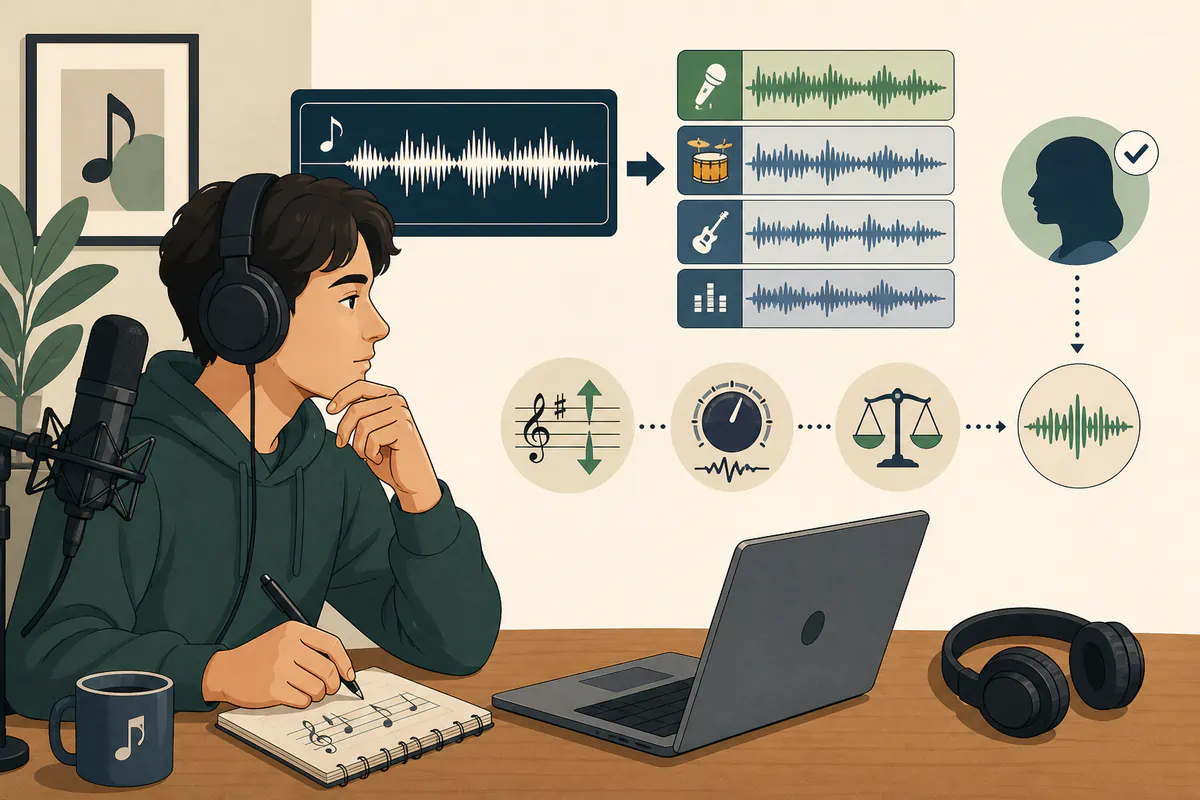
An AI cover song is a new version of an existing song created or modified with artificial intelligence. Depending on the tool and workflow, the result might feature a synthetic singer, a different musical arrangement, a genre transformation, or an AI-generated instrumental.
For example, a creator might use AI to turn a pop song into a jazz arrangement, generate vocals that sound like a choir, or replace a vocal performance with a synthetic voice.
These techniques are not legally identical. Generating an original song with an AI voice is different from recreating a copyrighted melody, using the original master recording, or making a singer sound like a specific celebrity.
The song itself
The melody, lyrics, and underlying musical composition may be protected by copyright, even when a different singer performs them.
The original audio
The released recording can have separate rights. Using its vocals, samples, or instrumental stems may require additional authorization.
The performer
Cloning or imitating an identifiable person’s voice can raise consent, publicity, privacy, contract, or other legal issues, depending on the jurisdiction.
The generated version
The AI tool’s terms, the amount of human creative contribution, and any incorporated protected material affect what you can use and own.
The U.S. Copyright Office explains that musical compositions and sound recordings are separate copyrighted works. Review its music copyright guide for a useful introduction to these distinctions.
2. Can You Legally Make an AI Cover of a Copyrighted Song?
Sometimes, but it depends on what you use, where you live, how you distribute the cover, and whether the relevant rights are licensed. There is no universal rule that makes every AI cover legal simply because the vocals or backing track were generated by AI.
A conventional cover usually involves recording a new performance of an existing composition. An AI cover may also reproduce the original melody and lyrics, use source audio, imitate a particular performer, or create an arrangement that requires separate authorization.
Understand the main rights involved
| Right or issue | Why it matters | What to check |
|---|---|---|
| Musical composition | Can cover melody, lyrics, and other protected songwriting elements. | Whether your planned use is licensed or otherwise legally permitted. |
| Original master recording | Can apply when you reuse audio from the commercial release. | Whether you have permission to use samples, vocals, or stems. |
| Adaptation or arrangement | Changing lyrics, translating a song, or substantially adapting it may require additional rights. | Whether the proposed changes are covered by the license. |
| Voice or likeness | Imitating an identifiable person can create separate legal and contractual concerns. | Consent, applicable local laws, and the tool’s restrictions. |
| Platform and distribution | Services may impose their own copyright, AI, and monetization policies. | Current upload rules and the exact scope of any license. |
A license for one type of use does not necessarily cover all the others. For example, authorization to use a composition does not automatically grant permission to use the original recording or clone the original singer’s voice.
3. Choose the Safest Approach for Your AI Cover
Option 1: Use a song in the public domain
Public-domain music can be a useful starting point, especially if you want to experiment with AI arrangements without negotiating with a contemporary songwriter or publisher. However, public-domain status depends on the country, the work, and its publication history.
An old composition may be in the public domain while a modern recording or arrangement of it remains protected. Create your own recording or use audio whose license clearly permits your intended use.
Option 2: Get permission from the relevant rights holders
If you want to make an AI cover of a commercially released song, identify the songwriter, publisher, recording owner, or authorized licensing representative. Explain exactly what you intend to do.
Your request should clarify whether you plan to:
- Reproduce the original melody and lyrics.
- Use an AI-generated vocal or clone a particular singer’s voice.
- Change the lyrics, translate the song, or make a substantial adaptation.
- Upload audio-only content or pair the song with a video.
- Monetize, distribute, advertise, or sell the resulting track.
Ask for written authorization that covers the actual use you intend. If you need rights for a music video, commercial release, or recognizable voice imitation, make sure the agreement addresses those uses explicitly.
Option 3: Create an original song with AI
If your goal is to publish and monetize music with fewer copyright complications, create an original composition instead of copying an existing song. Use original lyrics, a new melody, and a voice that does not imitate an identifiable performer without authorization.
Check the AI music service’s terms for commercial-use permissions, restrictions, attribution requirements, and rules about uploaded material. Commercial-use permission from an AI platform does not necessarily clear third-party copyrights in the output.
Option 4: Use a licensed cover-song distribution service
Some distributors offer cover-song licensing or help creators obtain the necessary permissions for eligible releases. Read the eligibility rules carefully. A standard cover-song license may not cover remixes, samples from the original recording, rewritten lyrics, or every kind of AI-generated adaptation.
For an example of a distributor’s requirements, review DistroKid’s official help center. Do not assume that using a distributor automatically clears every right involved in an AI cover.
4. How to Make an AI Cover Song Legally: Step by Step
Follow this workflow before generating, editing, or publishing a cover. The steps are designed to help you identify legal risks early instead of discovering them after uploading the track.
Step 1: Decide what kind of cover you want
Write down whether you want to preserve the original lyrics and melody, create a new arrangement, use an AI voice, or recreate a particular singer’s vocal style. The more your project relies on protected material or an identifiable performer, the more carefully you should review the required rights.
Step 2: Identify the composition and recording
Research the song’s writers, publisher, and recording owner. Do not assume that the artist who performs a song owns every relevant right. A record label, music publisher, or other rights holder may control different parts of the project.
Step 3: Check the AI tool’s terms
Before uploading a track or generating vocals, read the provider’s current terms of service. Look for provisions about commercial use, rights in generated output, voice cloning, user-uploaded audio, and prohibited impersonation.
Also confirm that you are allowed to upload the source file. A tool accepting a file technically does not mean that you have the legal right to process it.
Step 4: Secure the necessary permissions
Obtain the permissions that apply to your particular workflow. These may include rights for the composition, use of the original master, adaptations, synchronization with video, or a person’s voice and likeness. The exact requirements depend on your jurisdiction and use.
Step 5: Generate and edit your cover
Use only authorized source material and permitted tools. If you are using an AI voice model, verify that the voice is licensed for your purpose or that the person whose voice is being replicated has given appropriate consent.
Keep project files, source licenses, consent records, receipts, and correspondence. These documents may help you demonstrate what you were authorized to do.
Step 6: Review the finished audio
Listen for copied audio, unauthorized samples, changes to protected lyrics, and vocals that could misleadingly suggest a real artist participated in the recording. Review any cover artwork, artist names, and promotional text for similar issues.
Step 7: Check the destination platform
Review the current rules for your intended platform before publishing. YouTube, music distributors, and social networks may have different licensing arrangements, AI disclosure requirements, and procedures for handling copyright claims.
Step 8: Publish accurately
Use truthful titles, credits, and disclosures. Do not imply that a well-known artist sang, approved, or endorsed your cover unless that is true. Follow the platform’s applicable rules for synthetic or altered content.
5. Can You Use an AI Voice That Sounds Like a Famous Singer?
This is one of the most sensitive aspects of AI music creation. A voice model that sounds like a particular singer may raise concerns even if you do not use that singer’s original recording.
The legal treatment of voice imitation differs between countries. Depending on the circumstances, relevant rules may involve publicity rights, privacy, consumer protection, unfair competition, contracts, or other laws. The absence of a copied audio file does not guarantee that an imitation is lawful.
Lower-risk approach
Use a licensed synthetic voice, your own voice, or a consenting vocalist. Choose a broad musical genre rather than asking a tool to reproduce an identifiable person’s voice.
Higher-risk approach
Clone a celebrity without consent, use their name to attract listeners, or present generated vocals as an authentic performance by that person.
If you work with a real vocalist, obtain written consent that defines the permitted voice-model training or processing, uses, platforms, duration, payment, and any restrictions on future reuse. Consent to record one song may not automatically authorize creating a reusable AI voice model.
6. Can You Upload AI Cover Songs to YouTube?
You can upload music to YouTube only subject to applicable copyright law and the platform’s rules. An AI cover can still trigger a Content ID claim, a takedown request, or other restrictions even if you created the new instrumental and generated the vocals yourself.
YouTube explains that copyright owners can control how their works are used and that even apparently permitted uses are not guaranteed to avoid copyright disputes. Read YouTube’s official copyright guidance before uploading.
What about monetization?
Monetization is not guaranteed. Depending on the rights holder’s policies and the applicable agreements, a video may be monetized by the rights holder, have revenue shared, be blocked in certain territories, or be removed. Platform claims and legal permission are different questions.
Do you need to disclose AI-generated content?
Check YouTube’s current altered or synthetic content disclosure requirements. Realistic synthetic audio that makes it appear a real person said or sang something they did not may require disclosure under the platform’s rules. Follow the current instructions shown in YouTube Studio and do not use disclosure as a substitute for obtaining the necessary rights.
Will writing “no copyright infringement intended” protect you?
No. A disclaimer does not grant a license, establish consent, or automatically qualify a video for a copyright exception. Crediting the original artist is good practice, but attribution alone does not replace permission when permission is required.
7. Can You Release an AI Cover on Spotify?
Releasing an AI cover through a distributor requires you to comply with both the distributor’s rules and the rights applicable to the recording. A distributor may offer licensing for certain conventional covers, but that does not mean every AI-generated version is eligible.
Before submitting a release, verify the following:
- The composition is properly licensed for the intended release.
- Any source audio or samples are authorized.
- Any substantial adaptation or lyric change has the necessary approval.
- The AI voice and tool are permitted for commercial distribution.
- The distributor accepts the particular AI-generated content.
- Artist names, credits, artwork, and promotional claims are accurate.
Do not select a standard cover-song option if your track is actually a remix, contains unauthorized samples, or substantially changes the original work beyond the license’s scope. Ask the distributor or a qualified music-rights professional when the classification is unclear.
8. What If the Song Is in the Public Domain?
Public-domain material can simplify the process, but you should verify the status of the exact work rather than relying only on its age. Copyright duration and transitional rules vary by country, and different versions of the same song may have different legal status.
Before using a supposedly public-domain song:
- Confirm the status of the composition in the country where you will use it.
- Check whether the lyrics and melody are part of the public-domain work.
- Avoid assuming that a recent arrangement or translation is also free to use.
- Use a recording you made yourself or audio with a suitable license.
- Retain evidence of your research and any applicable licenses.
YouTube provides general guidance on copyright and public-domain content, including the importance of verifying public-domain status before uploading.
9. Are AI-Generated Songs Copyright-Protected?
The answer depends on the country and the creative process. In the United States, the Copyright Office has stated that AI-assisted works may qualify for copyright protection when there is sufficient human authorship, but merely entering prompts is not enough by itself.
Human contributions such as original lyrics, musical composition, creative arrangement, and meaningful editing may be relevant. The precise analysis depends on the work and the nature of the contribution. Other jurisdictions may apply different standards.
Read the U.S. Copyright Office’s Artificial Intelligence resources for further information.
10. Common Mistakes to Avoid
Assuming AI means copyright-free
A generated performance can still incorporate a protected melody, lyrics, or other material.
Using the original recording without permission
Feeding a commercial recording into a model does not automatically authorize copying or distributing it.
Cloning a voice without consent
The tool’s technical capabilities do not establish legal permission to replicate a real person’s identity.
Assuming a platform will clear everything
A distributor or social network may handle some licensing arrangements but not all rights in an AI cover.
Relying on a disclaimer
Giving credit or stating that a song is unofficial does not automatically make its use lawful.
Ignoring the AI tool’s terms
A subscription may permit some commercial uses while restricting voice cloning, source uploads, or particular types of output.
11. AI Cover Song Legal Checklist
Use this interactive checklist before publishing. It is a planning aid, not a legal determination or a guarantee that your cover is authorized.
0 of 7 checks completed
12. Frequently Asked Questions
Is it legal to make an AI cover song for personal use?
Personal use may involve fewer practical distribution risks, but it is not automatically exempt from copyright law. The rules depend on the source material, the actions you take, and the jurisdiction. Uploading or sharing the cover can introduce additional issues.
Can I monetize an AI cover on YouTube?
Possibly, if the relevant rights and platform requirements are satisfied. A video can still receive a copyright claim, have its revenue redirected, be restricted, or be removed. Permission to use a song and eligibility for YouTube monetization are separate matters.
Can I use AI to make a song sound like a famous singer?
Do not assume that it is permitted. Voice cloning or a recognizable imitation may raise consent, publicity, privacy, contractual, or other legal issues. Use an appropriately licensed voice or obtain informed consent where required.
Does changing the genre make an AI cover legal?
No. Turning a song into jazz, metal, lo-fi, or another genre does not automatically remove the copyright in its underlying melody or lyrics. The rights needed depend on the material used and the changes made.
Can I upload an AI cover if I give credit to the original artist?
Credit is not a substitute for permission. You should still verify the applicable composition, recording, adaptation, and platform requirements before publishing.
Can I use a song that is no longer popular or has very few streams?
Popularity and streaming numbers do not determine copyright status. A little-known song may remain fully protected. Verify its legal status and permissions just as you would for a hit song.
Is an AI cover legal if the original singer never recorded it?
Not necessarily. Even if you generate an entirely new vocal performance, the underlying composition may still be protected. Imitating a particular singer can also raise separate concerns.
Do AI music subscriptions include commercial rights?
It depends on the service, subscription tier, terms in effect when you create the track, and the content you provide. Read the current agreement and remember that commercial-use rights from a tool do not automatically clear third-party material.
What should I do if my AI cover receives a copyright claim?
Review the claim details, identify the material being claimed, and check your licenses and records. If the claim is valid, follow the platform’s available options. Dispute it only when you have a genuine legal basis and supporting evidence. Seek professional advice if the dispute could have significant consequences.
13. Official Resources for AI Music and Copyright
Copyright rules differ by country, so use official sources and jurisdiction-specific advice for your project. The following resources are useful starting points:
- U.S. Copyright Office: What Musicians Should Know About Copyright — explains the difference between musical works and sound recordings.
- U.S. Copyright Office: Artificial Intelligence — provides official information about AI and copyright.
- YouTube: Copyright — outlines copyright concepts, public-domain material, and options for using protected content.
- World Intellectual Property Organization (WIPO) — offers international intellectual-property resources.
- DistroKid Help Center — provides distributor-specific information about releasing cover songs.
Conclusion: Make AI Covers With Rights in Mind
Making an AI cover song legally starts with understanding the material you are using. The original composition, the commercial recording, and the identity of a real singer can raise separate issues. A new AI performance does not automatically clear those rights.
For the lowest-risk workflow, use original or verified public-domain material, choose properly licensed AI tools and voices, obtain the necessary permissions, and check the rules of every platform where you intend to publish. Keep records of the rights you have secured.
If you plan a major commercial release, an advertising campaign, or a recognizable imitation of a real performer, consult a qualified music-rights lawyer in the relevant jurisdiction before proceeding.
Disclaimer: This article provides general educational information, not legal advice. Laws, licensing arrangements, and platform policies can change. Requirements depend on the country, the material used, and the intended use.