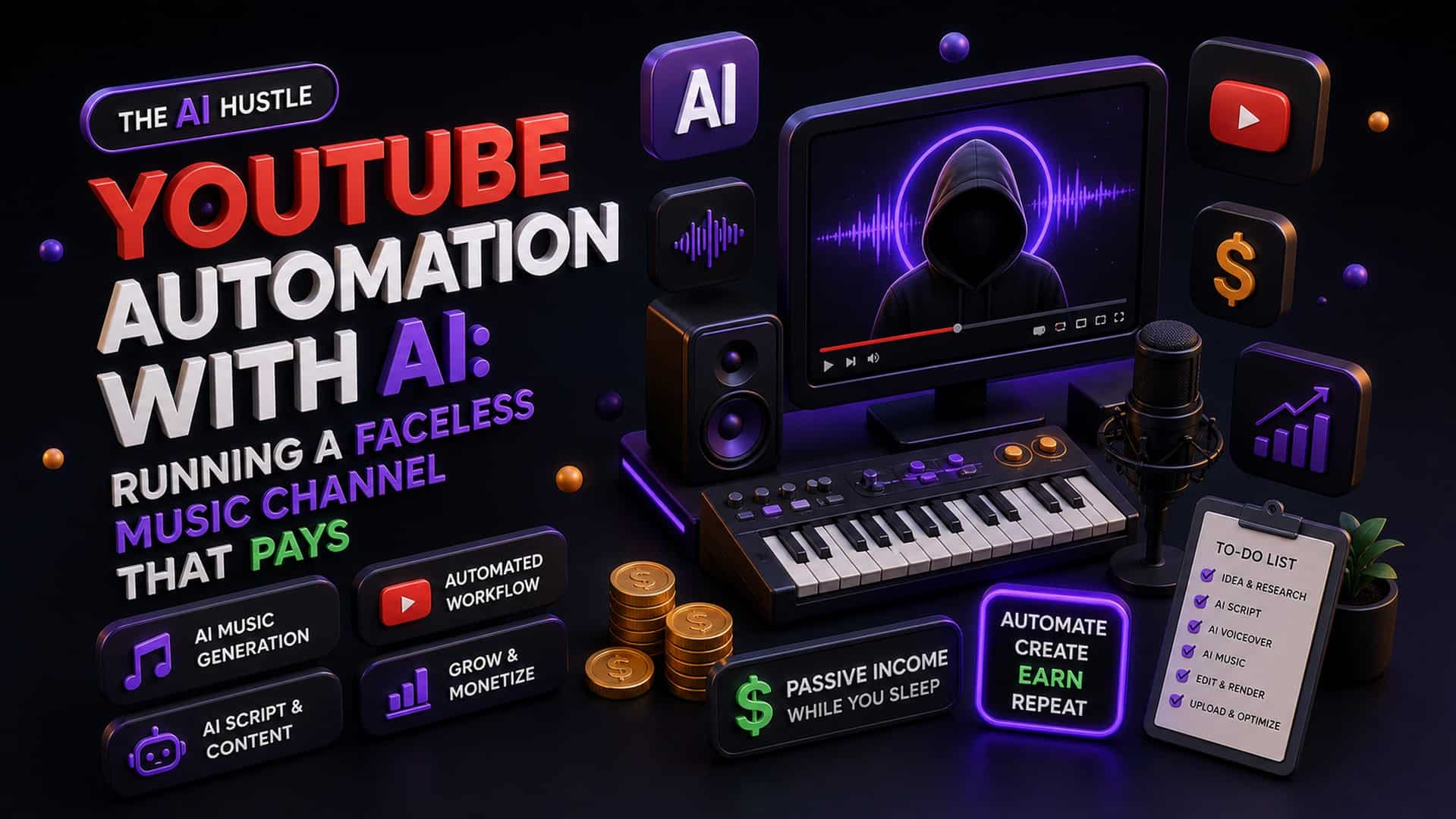
Yes, you can potentially monetize a YouTube channel that features AI-generated music. However, earning money depends on more than the tool you use to create songs. You need the appropriate music rights, original and valuable content, compliance with YouTube’s monetization policies, and any required AI disclosures.
Whether you create instrumental tracks with AI, publish relaxing music, produce AI-assisted songs, or build a music channel from scratch, this guide explains the rules, common mistakes, and practical steps to improve your chances of monetization.
Can YouTube Monetize AI-Generated Music?
YouTube does not impose a blanket ban on AI-generated music. Creators can use AI as part of their creative process and may qualify for the YouTube Partner Program (YPP) when their content satisfies the platform’s rules.
There are three separate questions to consider:
Do you have the music rights?
Your AI music service’s terms must permit your intended use. Commercial-use permission, copyright ownership, and exclusivity are not necessarily the same thing.
Is your channel original?
YouTube evaluates whether the channel offers meaningful creative, educational, or entertainment value instead of mass-produced or repetitive content.
Are you following YouTube’s rules?
Your channel must meet YPP eligibility requirements and comply with copyright, advertiser-friendly content, and applicable AI-disclosure policies.
Review the official YouTube channel monetization policies before building a business around AI-generated music.
1. What Types of AI Music Channels Can Be Monetized?
The format of your channel matters less than the originality, quality, rights, and value of the content. These examples illustrate different approaches, not guarantees of approval.
Original AI-assisted songs
Create songs using your own concepts, lyrics, arrangements, editing, and production decisions. Document the rights granted by your music generator and any third-party materials you use.
Potential: A channel with distinct songs and a recognizable creative direction.
AI music with original visuals
Pair original compositions with thoughtfully produced animations, music videos, visual storytelling, or behind-the-scenes explanations of your process.
Potential: Videos that offer more than a generic image and an interchangeable soundtrack.
Educational music content
Publish tutorials, comparisons, reviews, and demonstrations showing how you create music with AI tools. Add original commentary and explain your decisions.
Potential: Content with clear educational value and creator involvement.
Relaxing or ambient music
Create sleep music, meditation soundtracks, focus music, or ambient compositions with meaningful differences in sound design, structure, and presentation.
Potential: Original listening experiences rather than a large collection of nearly identical uploads.
2. The Biggest Risk: Repetitive or Mass-Produced Music Videos
One of the most important considerations for AI music creators is YouTube’s policy on inauthentic content. YouTube clarified in July 2025 that its existing rules on repetitive content also cover content that is mass-produced. This is not a blanket ban on AI, but it makes originality and meaningful variation particularly important.
For example, imagine a channel that generates hundreds of tracks, places each one over the same static image, uses nearly identical titles, and uploads them in rapid succession with little creative differentiation. That approach may struggle to demonstrate the original value YouTube expects from monetized channels.
| Higher-risk approach | Stronger alternative |
|---|---|
| Uploading dozens of nearly identical AI tracks. | Developing distinct compositions, moods, structures, and musical ideas. |
| Using the same generic visual for every song. | Creating original artwork, animations, or visuals suited to each release. |
| Publishing AI songs with no context or creative identity. | Building a recognizable channel, with original concepts and clear musical themes. |
| Automatically generating titles and uploading without review. | Editing, checking, and presenting each release with accurate metadata. |
| Creating repetitive long videos from short loops with minimal variation. | Designing intentional long-form listening experiences with thoughtful arrangement and transitions. |
Read the current monetization policy for YouTube’s examples of eligible and ineligible content.
3. Does AI Music Need to Be Copyright-Free?
You do not necessarily need music that is in the public domain. You do need the rights or permissions required for your intended use, including commercial use if you plan to monetize the video.
AI music services can grant different permissions. Some may allow commercial use under certain paid plans, while other plans may impose non-commercial restrictions. The terms may also distinguish between the right to use a track and ownership of copyright in the generated output.
Check these details before publishing
- Whether the specific song was created under a free or paid plan.
- Whether monetized YouTube videos are an allowed use.
- Whether the terms cover distribution, streaming, and use on other platforms.
- Whether you need to credit the music generator or another rights holder.
- Whether the license includes limitations on commercial projects or client work.
- Whether the output contains samples, lyrics, voices, or other material that raises separate rights concerns.
- Whether the service’s terms changed after you created the track.
Can you use Suno-generated music?
Suno’s published guidance distinguishes between songs created under its free Basic plan and songs created while subscribed to eligible paid plans. Its terms have generally restricted commercial use of Basic-plan songs while providing commercial-use rights for eligible songs created during a paid subscription.
Do not assume that upgrading later automatically grants commercial rights to every song you previously generated. Check the applicable terms for the specific track and account plan.
Official resources:
What about Udio and other AI music tools?
Check the current terms of Udio or whichever generator you use. Confirm the commercial permissions, restrictions, attribution rules, and any conditions relating to downloads and distribution.
A paid subscription does not automatically guarantee that every output is copyrightable, exclusive, free of third-party rights, or immune to a Content ID claim.
4. YouTube Monetization Requirements for AI Music Channels
Having a license for your songs does not automatically qualify your channel for advertising revenue. You must also meet the applicable YouTube Partner Program eligibility requirements.
For the standard advertising-revenue eligibility route, YouTube generally requires a channel to reach one of the following thresholds:
Long-form video route
1,000 subscribers
Plus 4,000 valid public watch hours from long-form videos during the previous 12 months.
Shorts route
1,000 subscribers
Plus 10 million valid public Shorts views during the previous 90 days.
Meeting a numerical threshold does not guarantee acceptance. YouTube reviews the channel against its monetization policies, and other eligibility conditions apply.
In eligible countries and regions, YouTube also offers an expanded YPP entry tier with lower thresholds for certain fan-funding and shopping features. That lower tier is not the same as qualifying for full advertising revenue.
Because eligibility conditions and available features can change, check the official YouTube Partner Program eligibility guide and the Earn tab in YouTube Studio.
5. Do You Need to Disclose AI-Generated Music?
Yes, in certain cases. YouTube’s current disclosure guidance specifically lists AI-generated music as content that creators need to disclose when music is the main focus of the video.
This matters particularly for channels publishing full AI-generated songs, albums, instrumental tracks, or music videos where the generated music is the central content.
How to disclose AI-generated music
- Open YouTube Studio and start uploading your video.
- Complete the title, description, and other video details.
- Find the AI disclosure setting in the upload details, under the relevant attributes section.
- Select the appropriate answer indicating that the content contains AI-generated music when required.
- Complete the upload process and review the published video details.
YouTube may add a label to the video when the disclosure applies. Its guidance says that making the required disclosure does not, by itself, limit a video’s audience or make it ineligible for monetization.
Read the official YouTube guidance on disclosing AI-generated or altered content.
6. How to Build an AI Music Channel That Adds Original Value
If you want to build a sustainable music channel, focus on making each release useful, distinctive, and recognizable. AI can assist with production, but your creative direction and presentation still matter.
Develop a specific musical identity
Instead of publishing random tracks across every possible genre, consider focusing on a clear audience or listening purpose. Examples include cinematic background music, original electronic compositions, ambient soundscapes, instrumental hip-hop, or music for focused work.
Create distinct compositions
Give each track its own structure, melody, instrumentation, arrangement, and atmosphere. Review the generated output, edit weak sections, and remove unwanted artifacts before publication.
Make the visuals part of the experience
Create original cover art, animated backgrounds, lyric videos, or visual storytelling that complements the music. Avoid relying entirely on interchangeable templates if the result provides little value beyond the audio file.
Show your creative process
Consider publishing tutorials about how you develop prompts, compare AI-generated versions, edit arrangements, mix tracks, or select the final output. Original explanations can help viewers understand what you contribute.
Organize releases into meaningful series
Playlists such as “Cinematic Music for Storytelling” or “Ambient Music for Deep Focus” can make a channel easier to navigate. Keep the tracks and videos in each series meaningfully differentiated rather than uploading many near-duplicates.
7. Can You Monetize AI-Generated Sleep Music and Long Playlists?
Potentially, yes. Long-form ambient music, sleep music, meditation soundtracks, and focus playlists can attract repeat listeners. However, duration alone does not make a video eligible for monetization.
A channel should demonstrate original creative work and a worthwhile listening experience. Simply generating many similar tracks, combining them with a static image, and repeating the same template can create problems during a monetization review.
Ways to improve a long-form AI music video
- Build a coherent composition or intentionally arranged collection of tracks.
- Use transitions that make the listening experience feel continuous and deliberate.
- Create original visual content that fits the music and adds value.
- Keep accurate track titles and descriptions.
- Make sure the entire video uses music you are authorized to publish and monetize.
- Avoid creating a large number of nearly identical videos with only superficial changes.
There is no universal rule that a static image automatically disqualifies a music video. The wider question is whether the channel’s content satisfies YouTube’s originality and authenticity standards.
8. Common Reasons AI Music Channels May Fail Monetization Review
| Potential issue | Why it matters | Practical response |
|---|---|---|
| Mass-produced tracks | The channel may appear repetitive or inauthentic. | Focus on distinct creative work and meaningful differences between releases. |
| Unclear commercial rights | The license may not allow monetized use. | Check the generator’s terms and preserve proof of permission. |
| Copyright claims | A claim may affect monetization or availability of a particular video. | Investigate the claim and resolve any underlying rights issue. |
| Missing AI disclosure | Required disclosures may be missing, particularly for AI music as the main focus. | Review YouTube’s disclosure guidance and answer the upload questions accurately. |
| Reused or minimally changed material | The channel may not demonstrate enough original contribution. | Use authorized source material and add substantial original creative value. |
| Misleading metadata | False claims about artists, ownership, or the nature of a track can create policy and trust problems. | Use accurate titles, descriptions, credits, and artist information. |
9. Can AI Music Receive Copyright Claims Even if You Have a License?
Yes. A Content ID claim can occur even when you believe you have permission to use a track. Automated matching may identify similar audio, or a rights holder may assert a claim that needs to be reviewed.
A license is useful evidence, but it does not guarantee that YouTube will never flag the video. If a claim appears:
- Open YouTube Studio and inspect the claim details.
- Identify the claimed material and the part of the video affected.
- Compare the claim with the original AI-generated file and the terms that cover it.
- Contact the music service or claimant if clarification is needed.
- Use YouTube’s dispute process only if you have a valid basis and supporting evidence.
Do not assume that an AI-generated track is automatically copyright-free or that every claim is invalid. Also remember that a Content ID claim and a copyright strike are different processes.
10. Interactive Tool: Is Your AI Music Channel Ready for Monetization?
Use this checklist to identify areas to review before applying to the YouTube Partner Program. It is a planning aid, not an official YouTube eligibility assessment.
AI Music Channel Readiness Check
11. A Practical Strategy for Launching an AI Music Channel
If you are starting from scratch, prioritize quality and consistency instead of uploading as many tracks as possible.
Step 1: Choose a clear niche
Select a specific audience and musical direction. For example, focus music, cinematic instrumentals, original electronic songs, or ambient music for relaxation.
Step 2: Establish a repeatable creative process
Use AI to explore ideas, then review and refine the results. Keep notes about prompts, arrangements, editing decisions, and the final versions you choose to publish.
Step 3: Confirm the rights before publishing
Check the commercial terms of your AI music service and any additional assets. Save the relevant terms, receipts, original audio files, and project details.
Step 4: Build a recognizable channel identity
Develop consistent branding and accurate metadata. Each upload should still have a distinct purpose, composition, or creative presentation.
Step 5: Publish and learn from audience response
Use YouTube Analytics to identify which tracks attract viewers, encourage repeat listening, and retain attention. Let audience feedback inform future creative decisions rather than relying entirely on automatic bulk production.
Step 6: Apply when eligible
Monitor the Earn tab in YouTube Studio. When your channel meets the relevant requirements, apply and ensure that the overall channel complies with monetization policies.
Frequently Asked Questions
Does YouTube allow AI-generated music?
Yes. AI-generated music is not categorically banned from YouTube or the YouTube Partner Program. Your channel must still comply with monetization, copyright, and applicable AI disclosure policies.
Can I monetize songs made with Suno?
Potentially. Check the terms that apply to the specific song and account plan. Suno distinguishes commercial-use permissions for eligible paid-plan songs from restrictions that generally apply to songs created under its free Basic plan.
Can I monetize AI music made with a free tool?
Sometimes. The fact that a tool is free does not determine whether its outputs can be monetized. Read the service’s terms to confirm commercial-use permissions and any restrictions.
Can I upload AI music every day and earn money?
There is no universal daily-upload limit that determines monetization eligibility. However, publishing many nearly identical or mass-produced videos with little original value can make a channel ineligible under YouTube’s inauthentic content policy.
Can I monetize AI-generated sleep music with a static image?
It is possible for music videos with static visuals to be eligible, but a static image does not guarantee approval. YouTube assesses the overall content and channel, including originality, meaningful variation, and whether the videos appear mass-produced.
Do I have to disclose AI-generated music?
YouTube’s guidance specifically lists AI-generated music as content that requires disclosure when music is the main focus of the video. Review the current upload settings and disclose when required.
Does disclosing AI music reduce monetization?
YouTube states that making the required AI disclosure does not, by itself, limit a video’s audience or its eligibility to earn money. The video and channel must still satisfy all other applicable policies.
Can I use AI-generated music that sounds like a famous artist?
Be careful. A recognizable imitation may raise issues involving voice or likeness rights, platform policies, contractual terms, or protected musical material. Avoid unauthorized use of another person’s identity or copyrighted recordings.
Does a music license guarantee monetization?
No. A license may establish permission to use a track, but it does not guarantee YPP acceptance, copyright clearance in every situation, or a specific amount of advertising revenue.
How much money can an AI music channel earn?
Earnings vary widely based on monetized views, audience geography, viewer behavior, advertiser demand, content format, and channel eligibility. There is no fixed amount paid per view, and a channel that is not approved for monetization will not earn standard YPP advertising revenue.
Official Resources
- YouTube channel monetization policies
- YouTube Partner Program eligibility requirements
- Disclosing AI-generated or altered content
- Understanding Content ID claims
- Suno Terms of Service
Final Verdict: Is an AI Music Channel Worth Starting?
An AI music channel can be a viable creative project, and it may qualify for YouTube monetization. The strongest approach is to treat AI as a production tool rather than a substitute for original creative direction.
Choose a focused niche, develop distinctive compositions, create thoughtful visuals, confirm your commercial music rights, and follow YouTube’s disclosure requirements. Avoid relying on mass uploads of near-identical songs as your main strategy.
Most importantly, separate three goals: obtaining permission to use the music, producing content that meets YouTube’s originality standards, and qualifying for the Partner Program. Meeting all three gives your channel a stronger foundation, although monetization is never guaranteed.
This article is for general informational purposes and is not legal or financial advice. YouTube policies and AI music service terms can change. Check current official documentation before making business decisions.