
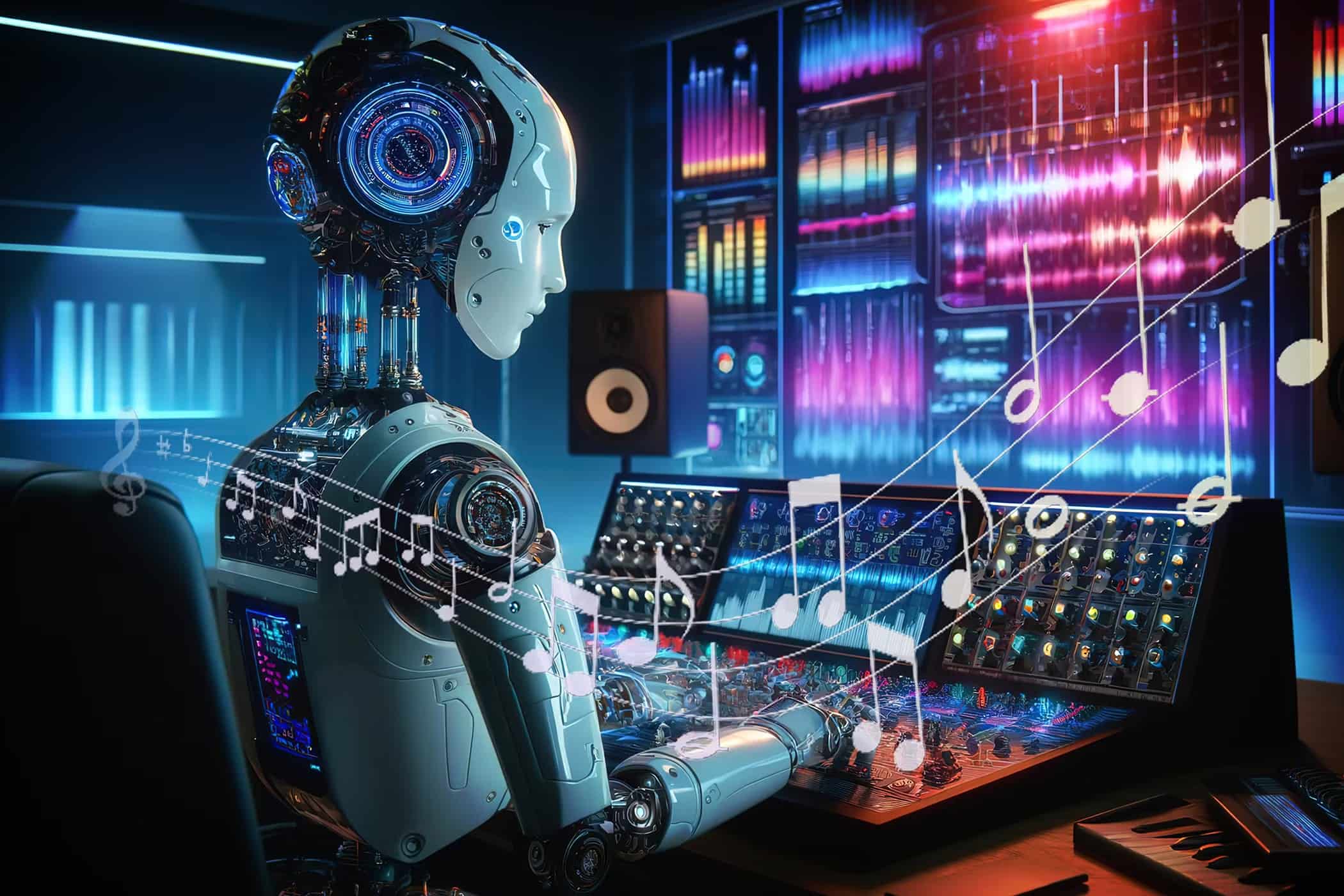
Generative AI music stands at a profound inflection point. The technology has advanced from novelty to market force—the global generative AI music market is growing at 30–59 percent annually and is projected to reach $2.8–7.4 billion by 2030–2035. Yet beneath the impressive growth metrics lies a fundamental tension that defines the era: the more control an artist exerts over AI-generated music, the less genuinely novel the output becomes; conversely, greater unpredictability can spark creative discovery but risks incoherence. The emerging consensus among researchers, musicians, and AI designers is that generative music’s value does not lie in replacing human creativity, but in augmenting it—AI as creative partner rather than substitute, handling raw material generation while humans provide curation, emotional direction, and artistic intent. However, this partnership model requires intentional system design, transparent governance, and artist advocacy. Without these safeguards, AI music threatens to homogenize culture, displace human musicians economically, and erode copyright protections that have long protected creative labor. This report examines the technical mechanisms of control and creativity in AI music, the market dynamics reshaping the industry, and the path forward for authentic co-creation.
The Market Reality: Scale and Adoption
The scale of AI music adoption has moved beyond emerging to mainstream in fewer than five years. As of 2025, 60 percent of musicians now incorporate AI tools into composition and editing workflows. The generative AI music market reached approximately $440–570 million in 2024 and is expected to reach $2.8 billion (at conservative estimates) to $7.4 billion (at aggressive forecasts) by 2030–2035, with compound annual growth rates between 30 and 59 percent depending on the segment. Within music production and recording specifically—the largest end-use segment—generative AI has become integral to workflows in both professional studios and home recording environments.
The most striking evidence of mainstream adoption is streaming platform integration. Spotify, Apple Music, YouTube, and Amazon Music are increasingly hosting AI-generated tracks alongside human-created music, often without transparent labeling. As of August 2025, 13 AI-generated artists on Spotify collectively attract 4.1 million monthly listeners, with the AI outlaw country artist “Aventhis” claiming over 1 million monthly listeners. These metrics represent not niche experimentation but genuine audience engagement at scale.
However, this market growth obscures a more troubling undercurrent: platforms are not simply enabling AI music; they are actively promoting it in algorithmic recommendations and editorial playlists. Internal Spotify strategy documents revealed in 2025 showed that the company has partnerships with production companies providing “music we benefited from financially” and teams working to seed AI tracks across playlists, effectively growing the percentage of streams directed toward AI-generated content—which is substantially cheaper to stream than licensed human-created music. This represents a structural incentive misalignment: what is economically rational for platforms (replacing royalty-bearing music with AI-generated alternatives) directly harms human artists.
The democratization narrative is simultaneously real and incomplete. AI music generation has genuinely lowered barriers to entry. Tools like Suno, Udio, AIVA, Boomy, and Musicfy allow individuals without musical training to generate professional-sounding compositions in minutes by entering text prompts or basic parameters. For marginalized communities historically overlooked in technology and music education, this accessibility is significant. However, the flip side is equally consequential: lower barriers do not guarantee greater diversity; they risk homogenization.
The Creativity Question: What Generative AI Actually Generates
A critical misunderstanding frames this debate: the question is not whether AI generates “real” creativity. Rigorous neuroscience and computational creativity research demonstrates that deep generative networks are demonstrably creative by established definitions.
Deep generative models—whether VAEs (Variational Autoencoders), GANs (Generative Adversarial Networks), or Transformer-based systems—generate novel musical outputs that are not memorized replicas of their training data. More strikingly, they generate outputs that make musical sense and possess contextual value, meeting the two-part criterion for computational creativity: novelty plus value. Research examining StyleGAN trained on images of human faces found that the network, having learned visual patterns, transferred those representations and generated coherent musical excerpts with no explicit music training. This is transformational creativity—a conceptual leap across domains.
Researchers have categorized three types of machine creativity within Margaret Boden’s framework:
Combinational Creativity (Most Common): The novel synthesis of familiar ideas. An AI system exploring harmonic progressions by combining chord types it has learned generates unexpected but musically coherent combinations. This is what most generative AI music currently achieves—not the creation of entirely new concepts, but sophisticated recombination.
Exploratory Creativity: Generating novel ideas within an established conceptual space. A generative model trained on jazz standards can produce reharmonizations or rhythmic variations that no human has previously notated but that cohere within jazz’s harmonic logic. Humans find these outputs surprising yet musically coherent.
Transformational Creativity (Rare, Powerful): Fundamental reshaping of a domain’s possibilities. This is how we classify Schoenberg’s atonality or the emergence of jazz from blues and African rhythmic traditions—shifts that alter what’s possible within music itself. Current AI systems are not independently achieving transformational creativity, but research suggests that human-AI collaboration might accelerate this rarest form of creative breakthrough.
The limitation is equally important: AI systems generate these outputs through statistical imitation of training data, not through intentional semantic expression. Where humans excel is imbuing music with meaning rooted in cultural context, emotional intention, and lived experience. An AI model trained on thousands of funeral marches will generate statistically coherent funeral march-like outputs; but the emotional weight that a human composer invests in a funeral march—the specific narrative of loss, the cultural particularity of grief—remains uniquely human. This asymmetry is not a flaw in AI; it clarifies where human creativity remains irreplaceable.
The Chaos Dimension: Structured Uncertainty and Emergent Creativity
The relationship between randomness and creativity in AI music is paradoxical and poorly understood until recent research. Unchecked randomness produces noise; complete determinism produces predictable repetition. The breakthrough insight is structured uncertainty—randomness constrained within meaningful boundaries.
Recent research by neuroscientist Koji Daikoku and colleagues (cited in the theoretical literature on AI music) demonstrates that intermediate levels of uncertainty optimize cognitive engagement and creative potential. Too much predictability bores; too much chaos overwhelms; the middle ground between order and disorder is where creativity thrives. This principle applies equally to human improvisation and to AI-generated music.
How Randomness Functions in Generative Systems
Most contemporary generative models employ a “temperature” parameter that controls randomness in output generation. Low temperature values (e.g., 0.1) encourage conservative, highly probable next notes—the model generates what it “expects” given its training. High temperature values (e.g., 0.9) increase exploration, allowing the model to sample from lower-probability possibilities. The artistic implication: at low temperature, a melody will be predictable and perhaps musically boring; at high temperature, unexpected note choices can spark novelty, but they risk disrupting musical coherence.
The sophistication lies in adaptive temperature. Research on diffusion models for music shows that these systems can encode aspects of human musical expectation and surprise. Rather than applying uniform randomness, systems can vary their exploratory behavior based on musical context. A model might be conservative when filling in a familiar harmonic progression but adventurous when exploring an unusual melodic contour. This context-sensitivity is what transforms randomness from noise into creative fuel.
Serendipity as Creative Resource
One of the most underexplored dimensions of AI music creativity is embracing model errors and unexpected interpolations as aesthetic resources. The unpredictability of large language models—which makes them sometimes produce nonsensical output in text—contains aesthetic potential when scaffolded with human creative intent. This echoes John Cage’s pioneering use of chance procedures and aleatoric music: unpredictability is not failure; it is a source of inspiration. Current systems produce these unexpected outputs as serendipitous side effects; the frontier is intentionally scaffolding human creators to tap into this uncertainty as a resource for discovery.
A producer might, for instance, run a generative model multiple times with varying parameters, discovering that a particular “error” or unexpected harmonic movement actually suggests a creative direction they hadn’t considered. The “mistake” becomes the muse. This requires that creators have visibility into what the system is doing and how it’s generating variation—which brings us to the critical question of control.
The Control Spectrum: From Precision to Serendipity
One of the central tensions in AI music design is the relationship between user control and creative novelty. Greater control enables artists to align generation with intent, but excessive constraint reduces serendipity. Different systems occupy different positions on this spectrum.
High Precision Control: Infilling and Conditional Generation
The Anticipatory Music Transformer, developed at Stanford and published in 2023, exemplifies high-control systems. Rather than generating music linearly from start to finish (the traditional GPT approach), this model enables “infilling”—the composer provides partial musical material (a melody, a chord progression, a rhythmic pattern), and the system completes or elaborates on it. The composer iteratively specifies what they want to compose and delegates to AI what they want generated, maintaining agency at each step.
The mechanics are powerful: the composer can accept, reject, or revise each AI-generated note, with acceptance feeding back into the system’s context for subsequent generation. The system can also adjust a probability parameter (p) from conservative (low p) to exploratory (high p), allowing the composer to shift between focused iteration and open exploration. This approach mirrors the actual human compositional process—sketching, editing, revising—rather than forcing composers into a generative workflow misaligned with how they actually work.
Emerging Fine-Grained Control: Head-wise Probing
Recent research on MusicGen, Meta’s generative music transformer, reveals that individual self-attention heads within the model learn to recognize and encode specific musical characteristics—instrument types, harmonic density, emotional tone, rhythmic patterns. This finding opens a pathway to inference-time control: rather than accepting whatever the model generates based on a text prompt, users could directly manipulate specific attention heads to refine particular dimensions of the output.
The practical implication is extraordinary granularity. A user could, for example, specify “classical composition with heavy metal drums” (a genuinely unconventional combination that text-to-music systems struggle with), and by manipulating the relevant attention heads, achieve precisely that hybrid. This level of control moves AI from “generate something close to my description” to “generate exactly this specific musical property within this other musical context.”
Real-time Interactional Control: Co-Creative Improvisation
At the other end of the spectrum are systems designed for real-time interactive co-creation, where human and AI adapt to each other dynamically. Research systems like SoMax 2 position the AI as an improvising partner that responds to live human input with stochastic (probabilistically variable) responses. The human musician plays something; the AI generates an accompaniment or response; the human reacts to that; the AI adapts. This creates what researchers call “interactional sense-making”—mutual creative shaping through reciprocal adaptation.
The key design principle is participatory sense-making: randomness is scaffolded by temporal structure, feedback channels, and mutual responsiveness. Surprises are welcome, but only if they cohere musically in context. A completely random response from the AI would break the interaction; a too-predictable response would bore. The optimal interaction happens when the system’s randomness is constrained by the immediate musical context and the human’s expressive intent.
Ideation Tools: Loose Constraints
At the most open end are simple generative systems like Melody RNN, which allow users to set basic parameters (temperature, seed melody length, etc.) and generate a batch of melodic variations, then select or develop the promising ones. These systems offer minimal real-time control but maximal exploratory capability. The user doesn’t directly shape the generation; instead, they sample the model’s idea space and curate the results. For composers seeking inspiration—overcoming creative block or exploring unfamiliar harmonic territories—this loose-constraint approach is often more useful than precise control.
The Co-Creativity Model: AI as Creative Partner
The dominant and most promising paradigm emerging across research, industry practice, and artist adoption is co-creativity: AI as creative partner that augments rather than replaces human creativity.
In this model, the AI handles the generation of raw material—a drum loop, a vocal line, a harmonic progression, a rhythmic variation. The human artist retains control over the strategic and expressive dimensions: establishing creative intent, curating which AI-generated elements serve that intent, processing and integrating AI material into the broader composition, and making final artistic decisions about arrangement, mix, and emotional arc.
What AI Excels At
Generative systems are particularly effective at:
- Rapid ideation: Generating multiple harmonic progressions or rhythmic variations in seconds
- Pattern synthesis: Creating novel combinations of patterns beyond a composer’s immediate experience
- Harmonic exploration: Suggesting unexpected but coherent chord movements
- Stylistic variation: Exploring how a musical idea could sound in different genres or emotional colorations
- Mechanical labor: Repetitive processes like drum programming, bass line creation, background harmony fill
What Remains Uniquely Human
Human creativity retains advantage in:
- Semantic expression: Imbuing music with meaning rooted in cultural context and lived experience
- Emotional authenticity: Conveying genuine emotional intention rather than algorithmic simulation
- Artistic vision: Maintaining coherent artistic direction across a composition
- Curation and judgment: Selecting which AI-generated material serves the larger artistic intent
- Narrative and arc: Creating meaningful progression and emotional journey through a piece
The Collaborative Workflow
Successful co-creative workflows follow a consistent pattern: the artist establishes clear creative intent before deploying AI, uses the tool to generate multiple options, evaluates those options against their artistic vision, selects and refines promising directions, and applies consistent personal processing and integration choices. The AI accelerates the exploration of possibility space; the human determines which possibilities matter.
Research into this model reveals a critical finding: artists report that their distinctive sound identity actually sharpens through AI co-creation, not because the AI contributes to their style, but because they spend less time on technical mechanics and more time on artistic curation. When a producer doesn’t have to spend days on drum programming, they can spend those hours on the emotional details that make their music distinctive.
The Market Structure Problem: Economics vs. Artists
While the creative collaboration model is theoretically sound and practically proven, the economic incentives driving platform adoption of generative AI point in the opposite direction.
Streaming platforms are fundamentally economics-driven systems. Spotify pays approximately $0.003–0.005 per stream to rights holders (labels, publishers, artists). The company’s margins depend on minimizing licensing costs while maximizing user engagement. AI-generated music, requiring no licensing payments and no royalties to original artists, is economically superior from the platform’s perspective. An AI-generated track that attracts one million streams costs Spotify essentially zero marginal licensing cost, compared to a human-created track that costs thousands in royalties.
Evidence emerged in 2025 that Spotify has systematized this strategy: internal investigations revealed that the company maintains partnerships with production companies providing cheap music and employees dedicated to seeding these tracks across playlists, effectively inflating the proportion of total streams directed toward cost-advantaged content. This is not hidden; it is simply not transparent to users who may assume the platform is algorithmically recommending the “best” music rather than the “cheapest-to-stream” music.
The consequence is direct: as AI-generated music proliferates and is algorithmically promoted, human artists’ visibility declines and per-stream revenues decline proportionally. Each AI track consuming streaming attention is streaming opportunity lost for human creators. This is not a side effect of democratization; it is the structural logic of the business model.
Deezer, by contrast, has adopted a different approach: the platform now prominently labels AI-generated tracks, excludes them from algorithmic recommendations and editorial playlists, and makes transparent that human artistry is the platform’s value proposition. This choice sacrifices the cost advantage of AI music in favor of artist and listener trust.
The Homogenization Risk: Democratization vs. Cultural Erosion
The accessibility of AI music tools genuinely democratizes music creation. Individuals in underserved communities, those without access to expensive studios or years of formal training, can now generate compositions that would have required professional resources or training.
However, this democratization exists in tension with a homogenization risk. AI trained on vast amounts of existing music learns patterns and probabilities from that existing corpus. Models trained primarily on Western popular music will naturally generate outputs biased toward those patterns. Regional and cultural musical traditions—the specific harmonic languages, rhythmic structures, and emotional sensibilities of non-Western traditions—are underrepresented in training data and thus underrepresented in AI generation.
Moreover, as AI-generated music becomes cheaper and easier, there is economic pressure toward formulaic content optimized for algorithmic discovery rather than cultural authenticity. A streaming platform optimized for engagement and cost reduction will promote AI music that fits proven patterns over human musicians exploring novel cultural directions.
The path forward requires intentional choices: training data diversity, economic structures that reward cultural authenticity over algorithmic optimization, and policy frameworks that protect regional and cultural musical traditions from erosion by algorithmically optimized content.
Copyright, Authorship, and Meaningful Human Involvement
The legal landscape for AI-generated music shifted decisively in January 2025 when the U.S. Copyright Office established that AI-generated works can receive copyright protection only when they embody “meaningful human authorship.” AI-generated music lacking sufficient human creative involvement falls into the public domain, where anyone can use it without legal constraint or royalty obligation.
This ruling has profound implications. First, it incentivizes intentional human curation: the more deliberate your creative decisions about what AI generates, how it’s processed, and how it integrates into your composition, the stronger your copyright claim. Second, it penalizes AI-only workflows: releasing pure algorithmic output exposes your work to free use by anyone.
However, significant ambiguity remains. What constitutes “meaningful” authorship? Does selecting AI-generated options count? Does processing and layering? Current guidance is case-by-case, and the boundary between meaningful curation and passive acceptance of machine output is not clearly defined. Musicians and producers should be cautious: document your creative intent, decision-making process, and processing choices. This becomes evidence of meaningful authorship should your copyright be challenged.
The training data question remains contentious and largely unresolved. Many AI music companies trained their models on copyrighted music without explicit permission, claiming “fair use.” Courts have not yet decisively addressed whether this constitutes copyright infringement or legitimate training use. Universal Music Group, Sony Music, and Warner Music Group have sued Suno and Udio for unauthorized use of copyrighted material. These lawsuits are ongoing and may not be resolved for years. In the interim, artists face legal uncertainty about which tools are legally sound to use.
Some platforms have taken ethical stances: SOUNDRAW and ProRata use in-house training data or secured licensing agreements; AI:OK is establishing ethical certification standards. Supporting these platforms creates market incentive for responsible practices.
Emotional Authenticity and Audience Skepticism
A persistent question shadows AI music adoption: can algorithmic music carry genuine emotional resonance?
Research on emotional expression in AI-generated music reveals a fundamental asymmetry. Neural networks trained on vast musical corpora can identify patterns correlated with emotional expression (e.g., minor keys with sadness, major keys with happiness, slower tempos with reflection). They can reproduce these patterns statistically. However, statistical correlation with emotion is not identical to intentional emotional expression.
When a human composer writes a funeral march, they are often drawing on personal experience with loss, cultural understanding of grief rituals, and intentional expressive choice about how to musically represent that emotion. An AI trained on funeral marches generates statistically coherent outputs correlated with the patterns of human grief-music; but the intentional emotional investment remains absent.
Listener research suggests audiences intuitively recognize this distinction. A 2026 study found that listeners are open to human artists using AI as a creative tool, but do not expect an AI-only artist to top the charts anytime soon. The implicit preference is for human authorship. This is not irrationality; it reflects the understanding that emotional authenticity derives from intentional human experience, not algorithmic pattern matching.
Regulatory and Industry Fragmentation
As of early 2026, the music industry is fragmenting around different responses to generative AI. Universal Music Group has committed to not licensing AI models trained on artists’ voices without explicit consent, setting a higher bar than industry practice. Other labels have settled with AI companies, but questions remain about whether those settlements adequately compensate artists whose voices trained the models (many deals involve label-level agreements without direct artist participation in licensing decisions).
Different regulatory jurisdictions are taking different approaches. The United Kingdom is considering permitting broad AI training on copyrighted works without explicit licenses (alarming to artist advocacy groups); the EU continues debating copyright reform; the United States remains in litigation with no definitive legislative framework yet. Tennessee became the first U.S. state to pass legislation protecting artists’ voices from unauthorized AI replication, but national standards are absent.
Industry initiatives like the AI:OK project, led by Dublin City University and supported by Universal Music Group, Insight SFI, and Enterprise Ireland, are attempting to establish trustmarks identifying music created with ethical AI practices—transparent training data, proper licensing, artist consent, and fair compensation. This self-regulatory approach may, if adopted broadly, create market differentiation for ethical tools.
Predictions and the Path Forward
| Timeframe | Trend | Implication |
|---|---|---|
| 2026-2027 | Frontier models with lower resource requirements; individual developers create rival-quality tools; flood of AI tracks on platforms | Competition intensifies; quality barriers lower further; human artist visibility challenges worsen |
| 2027-2029 | Licensing deals replace litigation; regulatory clarity emerges; AI market reaches 40-50% of total | Clearer legal frameworks; potential artist protection standards; industry consolidates around ethical vs. non-ethical approaches |
| 2030+ | AI potentially comprises 50% of music market; transformational creativity via human-AI collaboration; emotional AI potentially reaches human-equivalent resonance | Fundamental restructuring of music industry economics; critical period for artist advocacy to protect rights |
The most consequential variable is not technological but governance-oriented: Will the music industry protect human artists through transparent labeling, fair compensation structures, and artist consent requirements? Or will platform economics drive relentless substitution of human-created music with AI alternatives?
The future of AI music creativity depends on deliberate choices about how systems are designed, how training data is sourced, how platforms distribute AI output, and how artists are compensated and credited. Without intentional protective measures, the democratization of music creation will coexist with the erosion of musician livelihoods—a deeply unequal distribution of AI’s benefits.
Conclusion: Creativity Requires Intent
Generative AI music has proven that machines can generate outputs meeting multiple definitions of creativity: novelty, value, and even conceptual leaps across domains. The technology works. The question is not whether AI can be creative, but whether creative AI can coexist with human artists in an industry structured around extractive economic models.
The most compelling path forward is human-AI collaboration: AI handling raw material generation, exploration, and mechanical labor while humans retain curation, emotional direction, and artistic vision. This division of labor amplifies human creativity, not replaces it. Successful musicians and producers using AI today report stronger artistic identity, not weaker—because they spend less time on overhead and more time on art.
However, this optimistic scenario requires conditions that are not currently guaranteed: transparent platforms that label AI-generated content and promote human artistry with equal algorithmic weight; licensing frameworks that compensate artists for training data; regulatory protections for voice and likeness; and a critical mass of conscious creators who use AI as a tool for authentic co-creation rather than shortcut for inauthentic content.
The technology is neutral. The question of whether generative AI music will amplify or diminish human creativity depends entirely on the choices made by platforms, policymakers, and artists in the next 18–36 months. The window is narrow, but the stakes are clear: the future of music as a domain of human creativity and livelihood.