
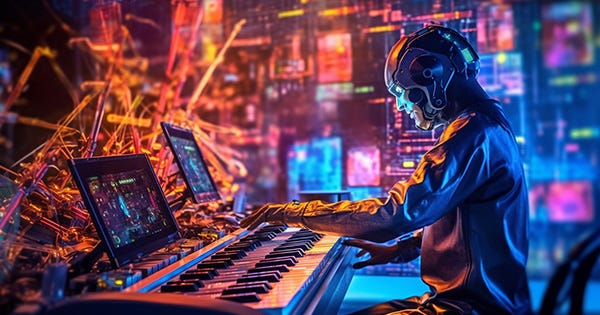
The answer is definitively yes—but only under specific conditions. Rigorous neuroscience research reveals that musical intuition emerges from hierarchical neural processing of contextual musical features, a capability that develops through repeated exposure, immediate feedback, and deliberate practice. AI systems designed with real-time feedback, adaptive difficulty, and responsive interaction can dramatically accelerate this development, not by automating musical thinking, but by providing the conditions expertise requires: immediate corrective feedback, responsive challenges calibrated to current ability, and concrete evidence of progress that builds confidence. The critical variable is not the AI itself, but the musician’s self-efficacy—their belief in their own capability. Research demonstrates a virtuous psychological cycle: AI provides immediate feedback and success experiences, which boost confidence, which enables deeper exploration of the tool’s capabilities, which generates more success and refines emotional intelligence, which ultimately sharpens intuitive musical judgment. When designed intentionally, AI becomes a tutor that accelerates what human musicians must develop on their own: the internalized pattern recognition that allows intuitive, automatic response to musical situations. This is enhancement, not replacement.
What Neuroscience Reveals About Musical Intuition
Musical intuition is not magical; it is a specific form of expertise. Recent neuroscience has illuminated its neural basis with remarkable precision, and this understanding explains both what musical intuition is and why AI can accelerate its development.
The Brain’s Hierarchical Processing of Music
A landmark 2025 study published in Nature examined how musical expertise shapes the brain’s encoding of music by comparing neural recordings from musicians and non-musicians listening to piano pieces. The researchers used computational models trained on classical music to predict the neural responses of both groups. The key finding was striking: musicians and non-musicians process music through fundamentally different neural hierarchies.
Both groups showed increasing neural prediction accuracy as the computational model moved through deeper layers—models that encode increasingly contextualized musical features (e.g., not just individual notes, but how those notes relate to the larger piece’s identity and structure). However, musicians’ brains continued to improve accuracy across deeper layers, while non-musicians’ brains plateaued. This difference was not due to better low-level acoustic processing (both groups handle basic pitch and timbre similarly), but rather in the ability to extract and encode contextual, disentangled musical features—the capacity to simultaneously hold multiple musical dimensions (pitch relationships, harmonic progression, rhythmic pattern, overall structure) in mind and recognize how they interact.
Crucially, this expertise-driven encoding is lateralized to the left hemisphere—musicians recruit distinct neural networks compared to non-musicians, with greater left-hemisphere involvement in musical feature analysis. The neural gradient extends beyond primary auditory cortex: regions progressively farther from primary auditory cortex show stronger encoding of high-level musical context in musicians. This anatomical distribution reflects the development of specialized, hierarchical processing that constitutes expertise.
Predictive Processing: The Engine of Musical Intuition
Musicians develop heightened automatic auditory sensitivity to melodic contours and enhanced predictive capabilities. This predictive processing is the neural correlate of intuition—the ability to anticipate the likely next direction of a musical phrase, recognize when something unexpected occurs, and respond appropriately. When an expert jazz improviser hears a chord progression and instantly generates a coherent melodic response, that is not conscious deliberation; it is predictive processing built through thousands of hours of exposure and interaction.
KAIST research on musical instincts reveals that these predictive capabilities emerge spontaneously from processing auditory information, without explicit instruction. The human brain, through exposure to music, develops cognitive functions for music naturally. This suggests that musical intuition is fundamentally built on pattern recognition—the brain’s capacity to extract statistical regularities from auditory experience and use those internalized patterns to predict and generate coherent musical responses.
Rhythm as a Marker of Intuitive Expertise
Machine learning analysis of rhythmic abilities provides additional insight into the physical substrate of musical intuition. When researchers trained classifiers to distinguish musicians from non-musicians, they found that the most informative features were not perceptual OR motor abilities alone, but their interaction. Musicians show both superior rhythm perception (the ability to detect beat alignment and deviations from regularity) AND superior motor production (the ability to produce rhythmically precise timing). More importantly, the interaction between perception and motor production—the feedback loop between listening and playing—accounts for the difference between musicians and non-musicians.
This has a profound implication: musical intuition is built on embodied, interactive feedback between what you hear and what you produce. It is not passive listening or abstract knowledge; it is the ability to hear something and respond with precision, and to use that response-feedback loop to refine both listening and motor control. This insight explains why real-time feedback systems can be so powerful in developing intuition—they recapitulate the very feedback loop that builds expertise.
How AI Accelerates the Development of Musical Intuition
Ear Training: From Passive Listening to Active Pattern Recognition
Modern AI-powered ear training tools like Keytone operate on a simple but powerful principle: they make the implicit explicit. When musicians listen to music, they are extracting patterns about chord structures, harmonic progressions, and melodic contours unconsciously. Traditional ear training attempts to develop this skill through abstract exercises and feedback hours later. AI ear training accelerates this by collapsing the feedback loop.
Keytone uses machine learning to analyze the chords and notes in any song—from Nirvana to Adele—and presents this analysis to the learner. The learner can play back portions of the song, see the harmonic analysis, and immediately test their own perception against the system’s analysis. Over time, engaging with this feedback, the musician begins to internalize the patterns. The technology works because it addresses a critical bottleneck: traditional ear training requires someone else (a teacher) to provide feedback, which means infrequent, delayed feedback. AI provides continuous, immediate feedback.
The typical workflow recommended by experts is 15–20 minutes daily, split into two parts: 10 minutes of focused ear drills (intervals, chords, rhythm patterns) and 10 minutes of guided lessons or instrument practice. The critical element is the sing-back mode—where learners hum intervals or sing chords—because the voice-to-ear connection rewires the brain faster than passive listening. After 2–4 weeks of consistent practice with AI guidance, musicians report reliable identification of 2–3 core intervals, clear discrimination of major versus minor triads, and the ability to decode small song fragments by ear.
This is not AI replacing ear; it is AI accelerating the internalization of auditory pattern recognition by providing what expertise requires: frequent, correct, immediate feedback with progressive difficulty adjustment.
Real-time Feedback Systems: Building the Expert’s Predictive Brain
Where AI becomes truly powerful in developing intuition is in real-time interactive systems. A growing category of tools provides moment-to-moment feedback during musical performance, allowing musicians to identify and correct errors in milliseconds rather than in review later.
Machine learning systems now analyze pitch, rhythm, dynamics, and expression in real-time as a musician plays, comparing actual performance to ideal targets. An AI system can detect that you are “rushing the third beat in that verse” or “pulling back during the chorus” and alert you instantly, allowing immediate correction. This real-time feedback creates a tighter feedback loop than traditional practice, where you might not notice a consistent timing issue until a teacher points it out hours later.
Research on AI-assisted violin practice shows that this real-time feedback produces measurable learning gains. Students using AI-assisted practice improved pitch accuracy, tempo consistency, and overall performance quality, while maintaining stable confidence as difficulty increased. The control group without AI showed natural decline in confidence as tasks became harder—a common feature of skill acquisition without support. The AI group, by providing achievement-affirming feedback, maintained self-efficacy and continued to improve.
Most strikingly, 85 percent of learners reported that immediate feedback (both auditory and visual cues) helped them identify and correct mistakes faster. This is not just faster learning; it is a different learning dynamic. When you correct a mistake immediately, you don’t ingrain the error, and the corrective movement becomes associated with the feedback, strengthening the connection between perception and motor production.
Responsive Real-time Accompaniment: Improvisation as Feedback Loop
One of the most direct ways AI can enhance intuition is through real-time interactive accompaniment systems. These are AI musicians (virtual or robotic) that listen to a human musician and respond in real-time, creating a duet where both participants adapt to each other.
Research on systems like Cadenza Live Accompanist and Virtual AI Jam reveals how these work. The human plays something; the AI listens and generates an accompaniment adapted to tempo, key, and style. The human responds to the AI’s accompaniment; the AI adapts further. This creates a feedback loop where musical intuition develops not through formal instruction, but through immediate reciprocal exchange.
Professional musicians interviewed about such systems consistently reported two preferences: (1) they valued accompaniment over free-form interaction (the ability to specify what kind of backing they wanted), and (2) they found the system effective for developing timing precision and rhythmic flexibility. Because the AI responds in real-time, the musician immediately experiences the consequence of timing choices—if you rush, the accompaniment gets ahead; if you drag, it lags. This creates exquisite sensitivity to timing within weeks of practice.
Remarkably, musicians using these systems show improvement in “sync precision and timing sensitivity over time”—the feedback loop literally trains the perceptual-motor interaction that defines rhythmic intuition. This is the neural basis of what feels like intuition—automatic, effortless timing—being developed through systematic AI feedback.
The Psychological Mechanism: Self-Efficacy as the Lynchpin
Here is the crucial insight from educational psychology research: AI systems do not directly enhance musical intuition. Rather, they enhance intuition indirectly through a chain of psychological mechanisms, with self-efficacy (belief in your own capability) as the critical link.
The chain works like this:
Stage 1: Immediate Feedback and Success
When you use an AI system for practice, you receive immediate feedback on specific, achievable targets. Chord identification is either correct or incorrect; your pitch is either on or off the note; your timing is either tight or loose. This discrete feedback, combined with achievable microtargets, allows frequent success experiences.
Stage 2: Enhanced Self-Efficacy
These successful experiences boost your confidence in your musical abilities. Psychologically, you begin to believe you can master skills that previously felt impossible. One study found that when students used Amper Music’s style-matching algorithm to complete cross-genre compositions, their sense of self-efficacy was enhanced by the perception of “breaking through skill boundaries.” That perception is crucial—you are not just improving technically; you are expanding your sense of what is possible for you musically.
Stage 3: Deeper Tool Exploration and Risk-Taking
Once your confidence is higher, you are more likely to explore the tool’s full capabilities. Rather than using a simple AI feedback system for basic pitch correction, you might experiment with its emotional recognition features, exploring how different harmonic moves affect perceived emotional tone. You are willing to take creative risks.
Stage 4: Refined Emotional Intelligence and Enhanced Intuition
As you explore these affective dimensions of music, you develop what researchers call “musical emotional intelligence”—the ability to identify, express, and regulate emotions through music. This is not separate from intuition; it is central to it. An intuitive musician is one who can sense what emotional direction a piece should move and respond accordingly. The AI provides an explicit learning interface for “musical emotion grammar”—the patterns by which minor keys, slower tempos, and sparse textures convey melancholy. You learn these patterns intellectually at first, then internalize them until they become automatic intuitive responses.
Stage 5: Virtuous Cycle Reinforcement
As you develop emotional intelligence, your creative outputs improve. These improvements further reinforce your self-efficacy, which prompts even deeper exploration, which generates further success. This is a virtuous psychological cycle, not a one-time intervention.
The research is explicit on this mechanism: individuals with lower self-efficacy will fail to fully leverage AI tools even if they possess technical readiness, because they lack intrinsic motivation to explore deeply. Conversely, experts (who have high self-efficacy) exploit AI tools much more fully than novices, extracting far more value because they experiment with more features and applications.
This explains why AI ear training works for some musicians and not others, and why some musicians develop remarkable intuition with AI-assisted practice while others stall: the difference is not the tool, but the psychological effect of the tool on the musician’s belief in their own capability.
Real-World Applications: From Classroom to Stage
Educational Settings: Accelerating Intuition Development
Music education has begun systematically integrating AI into curricula, with measurable results. Berklee College of Music has incorporated AI-assisted learning, and research on student outcomes shows consistent improvements in both technical skill and creative confidence.
The pedagogical model is straightforward: AI handles immediate feedback and difficulty calibration, freeing human teachers to focus on higher-order instruction—why certain harmonic choices work, how to use harmonic innovations expressively, how to develop personal voice and style. The AI teaches the pattern recognition underlying intuition; the teacher teaches how to apply intuition in service of artistic vision.
One specific application is adaptive composition learning. Students begin by composing simple melodies; AI provides feedback on whether they are tonal, coherent, and meet specified constraints. As they succeed, difficulty increases—perhaps the AI now asks them to compose reharmonizations or melodies in unfamiliar harmonic contexts. Rather than failing on these harder tasks (which would discourage them), the AI provides scaffolded feedback, suggesting harmonic approaches and allowing iteration. Students build confidence and intuition simultaneously.
Performance and Improvisation: Real-time Training
Jazz musicians and classical soloists are beginning to use AI accompaniment systems for practice and performance development. The Cadenza Live Accompanist system, for example, provides a full orchestral backing that follows the musician’s tempo, phrasing, and stylistic choices in real-time. A violinist practicing a Bach concerto can slow it down, take rubato (expressive timing changes), and the accompaniment adapts—providing the human feedback that practicing with human accompanists would require.
What is remarkable is that musicians report developing intuitive mastery of previously difficult skills—rubato, phrase breathing, dynamic shape—much faster with AI accompaniment than through traditional solo practice. This is because every interpretive choice receives immediate musical consequence (the accompaniment responds), creating exquisite feedback for refining expressive instinct.
Production and Real-time Feedback
Emerging AI tools for music recording provide real-time feedback during performance, not just analysis after the fact. Waves Clarity VX and iZotope Visual Mixer offer production-level feedback in real-time: if your vocal is too close to the microphone, the system alerts you; if you are clipping, it warns you before the take is ruined; if sibilance is excessive, it suggests correction strategies.
These systems train producers and musicians to “hear like a producer”—to develop intuitive understanding of technical and sonic dimensions. Rather than recording a take and discovering problems later, the musician gets moment-to-moment guidance that builds intuitive awareness of how their performance is translating to the digital signal. Over weeks of recording, this feedback internalizes into automatic awareness.
The Psychological Conditions Required for Enhancement
Self-Efficacy as Prerequisite
The research is clear: AI enhances musical intuition only when it successfully boosts the musician’s sense of self-efficacy and agency. This means:
- Frequent success experiences: The AI must be calibrated so that the musician succeeds regularly, not failures. Too-easy feedback is boring and doesn’t build confidence; too-hard feedback is demoralizing. Adaptive difficulty, which adjusts to the musician’s performance, is critical.
- Transparent, meaningful feedback: Feedback must be specific and actionable, not vague. “You’re flat” is less useful than “Your second note is 30 cents flat”—specific enough to correct immediately.
- Visible progress tracking: Metrics that show improvement over weeks (e.g., “interval identification accuracy increased from 62% to 78%”) are psychologically powerful. They transform abstract skill development into concrete evidence that effort is working.
- Autonomy within structure: The musician must feel agency in their learning. AI tools should offer choices (which skill to work on next, what difficulty level to attempt) within a structured framework. This allows the musician to feel ownership of their development.
The Risk of Over-Reliance
There is an inverse consideration: AI can also hinder intuitive development if it becomes a crutch. If a musician becomes dependent on real-time AI feedback to perform, and then performs without the AI, the intuitive foundation may be insufficient.
This is a real but manageable risk. The solution is to use AI as a temporary scaffold that is progressively removed. Early in learning, real-time feedback is essential; as skills develop, feedback should become less frequent and more subtle. Eventually, the musician should perform without AI feedback, having internalized the patterns AI helped them learn.
Research on AI-assisted violin practice addresses this by gradually reducing feedback frequency as learners improve, ensuring they develop independent error-detection ability. This scaffolding approach—where AI support gradually diminishes—allows the tool to enhance intuition without creating dependence.
The Distinction: Enhancement vs. Replacement
The critical distinction is between AI that enhances musical thinking and AI that replaces it.
AI that enhances intuition provides feedback on the musician’s choices, teaches pattern recognition, responds to the musician’s initiative, and systematically builds confidence. The musician remains the agent; the AI is the responsive environment.
Examples:
- Real-time ear training feedback on chord identification
- AI accompaniment that responds to the musician’s tempo and expression
- Production feedback that trains the ear for technical qualities
- Adaptive difficulty in practice exercises
AI that replaces intuition makes decisions for the musician, generates music without the musician’s intentional input, or absolves the musician of the need to make judgments.
Examples:
- Generative composition systems that produce finished pieces
- Auto-tune that removes the need to sing in tune
- Quantization that removes rhythmic variation
The difference is not subtle: one develops capability; the other obviates it. A musician using AI accompaniment for rhythmic feedback develops the rhythmic intuition; a musician using AI quantization to fix their rhythm does not.
The promise of AI is that it can provide the feedback and responsive environment that expertise requires—feedback that is usually only available with expensive private instruction and dedicated practice partners. In this sense, AI is democratizing access to the conditions that build intuitive mastery.
Evidence-Based Outcomes: What Research Shows
| Outcome | Change | Timeline | Source |
|---|---|---|---|
| Pitch accuracy | ±2% deviation (vs. ±5% control) | 8-12 weeks | |
| Tempo consistency | 2% deviation (vs. 5% control) | 8-12 weeks | |
| Interval identification accuracy | +10% improvement per two weeks | Ongoing | |
| Music Performance Self-Efficacy (MPSE) | Large effect size improvements | 6-8 weeks | |
| Learning confidence (as difficulty increases) | Maintained (control group declined) | 6-8 weeks | |
| Error identification speed | 85% report faster identification | Immediate | |
| Timing sensitivity (with real-time accompaniment) | Significant improvement | 4-6 weeks | |
| Skill retention post-training | 90% retention (vs. 65% control) | Post-assessment | |
The evidence is consistent: when AI is designed to provide immediate feedback, adaptive difficulty, and visible progress tracking, it produces measurable acceleration in skill development and sustained improvements in confidence and self-efficacy.
The Neuroscience-AI Alignment
The most important insight is that well-designed AI systems align with how expertise actually develops neurologically. Musicians develop intuition through:
- Repeated exposure to auditory patterns
- Immediate feedback on their responses
- Progressive challenge calibrated to current ability
- Responsive interaction that punishes sloppy work and rewards precision
- Conceptual integration where specific skills connect to larger musical structures
AI systems that provide all five of these elements accelerate the development of the hierarchical neural processing that constitutes musical expertise. The systems do not replace the neural development; they speed it up by providing optimal conditions for that development.
Research on how musicians’ brains process music shows that expertise is built through hierarchical feature extraction—learning to simultaneously encode pitch relationships, harmonic progressions, rhythmic patterns, and overall structure. Real-time feedback systems help this by making the hierarchy explicit (here’s the bass line, here’s the harmony, here’s the melody) and providing feedback on whether the musician is tracking all dimensions. Over time, this conscious, analytical processing becomes automatic, intuitive processing—the neural basis of musical intuition.
Potential Limitations and Unknowns
Research has not yet answered several important questions:
Neuroplasticity: Does AI-accelerated learning create the same neural pathways as traditionally-trained intuition? Or does it create different, shallower connections that work fine with AI feedback but break down without it? Early evidence suggests the former, but longitudinal studies are limited.
Transferability: Does intuition developed with AI feedback transfer to unaided performance? Preliminary evidence suggests yes if the AI support is gradually removed, but more research is needed.
Authenticity: Can AI-developed intuition express the same emotional depth as intuition developed through lived musical experience? This is partly a neuroscience question (do the same brain regions activate?) and partly a philosophical question about the role of struggle and embodied experience in developing artistry.
Stage Skipping: Can AI help musicians skip foundational developmental stages, or does deep intuition require time for neural consolidation? Some evidence suggests that accelerating surface skill development without foundational grounding can be counterproductive.
These unknowns do not invalidate AI’s potential to enhance intuition; they simply indicate that the technology should be applied thoughtfully, with attention to the psychological and neurological conditions that genuine expertise requires.
Practical Recommendations for Musicians
Based on research evidence, musicians seeking to develop intuition with AI support should:
- Choose feedback over generation. Prioritize AI tools that provide feedback on your own playing/singing over AI tools that generate music for you. The former enhances intuition; the latter risks replacing it.
- Ensure adaptive difficulty. The tool should increase challenge as you improve, not plateau at one level. Consistent success is demoralizing; consistent struggle is discouraging. The sweet spot is ~70% success rate, which means failures that feel challenging, not overwhelming.
- Seek real-time responsiveness. Tools that provide feedback milliseconds after your action are more effective than tools that batch feedback after a session ends. The tighter the feedback loop, the faster pattern recognition develops.
- Track visible progress. Use metrics (accuracy rates, speed of improvement, songs learned by ear) to document your development. These are not just bureaucratic; they are psychologically powerful reinforcements of self-efficacy.
- Plan for scaffolding reduction. Intend from the start to gradually reduce AI support as your intuitive capability develops. Use intense real-time feedback early, then shift to less frequent, more subtle guidance as you progress.
- Combine AI feedback with intentional listening. AI tools teach pattern recognition, but intentional listening to music you love—asking yourself why certain choices work—teaches intuition about expression and meaning. Both are necessary.
- Maintain creative autonomy. Use AI to enhance your choices, not to make choices for you. The moment AI becomes the decision-maker, enhancement shifts to replacement.
Conclusion: Intuition Accelerated, Not Diminished
The evidence is compelling: AI can enhance musical intuition by providing the conditions expertise requires—immediate feedback, adaptive challenge, responsive interaction, and visible progress tracking. The technology does not replace intuition; it accelerates its development by providing what human musicians usually must discover or wait years to access through expensive private instruction.
The mechanism is psychological and neurological: AI boosts self-efficacy, which enables deeper exploration, which generates success experiences, which refines emotional intelligence, which sharpens intuitive musical judgment. Over time, these feedback-supported learnings internalize into automatic, intuitive responses—the neural basis of musical expertise.
The critical variables are not technological but human: whether the musician’s self-belief is elevated, whether the learning environment is responsive and adaptive, and whether AI support gradually diminishes as capability develops. When these conditions are met, AI becomes what musicians have always sought—a patient, responsive practice partner that never tires, never makes excuses, and provides the kind of refined, immediate feedback that expert musicianship requires.
The future of musical development is not human or AI, but human intuition augmented by AI tutelage—the best of both: human creativity, intention, and expression amplified by technology that accelerates the expertise upon which great music ultimately depends.