
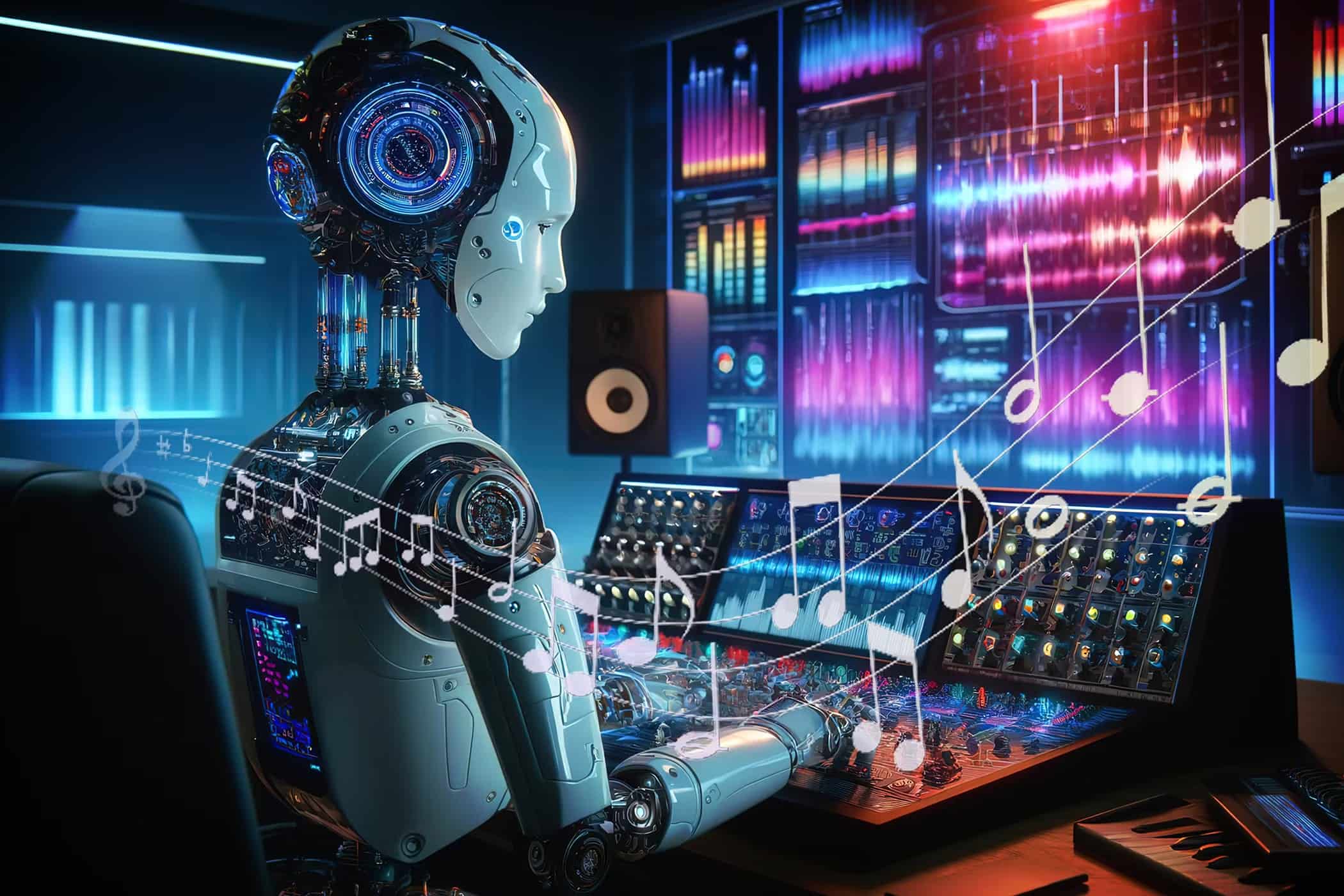
Artificial intelligence has fundamentally transformed music production from a specialized craft requiring years of training into an accessible creative tool. In 2026, 87% of producers incorporate AI into their workflows, with 79% using it for technical tasks and 66% deploying it creatively. Rather than replacing human musicians, the dominant pattern is collaborative augmentation: AI generates raw material—chord progressions, drum patterns, vocal arrangements—while humans provide curation, emotional depth, and artistic direction. This hybrid approach delivers measurable results: projects finish 35-50% faster, with 22% higher emotional engagement compared to pure AI outputs. However, a critical legal framework now governs this collaboration. The U.S. Copyright Office’s January 2025 ruling mandated that purely AI-generated compositions lack copyright protection—only works with “sufficient human input” qualify for legal protection and commercial licensing. Simultaneously, copyright disputes over unlicensed training data intensified, with 56+ lawsuits against AI platforms by October 2025. This report synthesizes the technical realities, creative workflows, legal requirements, and ethical implications of AI in music, providing both emerging musicians and established producers a comprehensive framework for navigating this transforming landscape.
Part I: How AI Generates Music—The Technical Foundation
Understanding the mechanics of AI music generation provides clarity on why these tools produce surprisingly human-like results and where they face limitations.
The Training Architecture
Modern AI music generation relies on three complementary deep learning architectures:
- Recurrent Neural Networks (RNNs) and LSTM Networks: These process musical sequences note-by-note, understanding dependencies between adjacent notes. They excel at melodic and harmonic progression because they model how one note influences the next.
- Transformer Models: Advanced architectures like OpenAI’s MuseNet and Google’s Music Transformer use attention mechanisms to identify relationships across longer musical passages, not just adjacent notes. This enables coherent song structure—verses, choruses, bridges—rather than disconnected loops.
- GANs (Generative Adversarial Networks): Two neural networks compete: one generates music, another criticizes it. This adversarial process refines output toward higher quality.
These models train on massive datasets—Google’s MAESTRO dataset, for example, contains thousands of hours of high-quality classical piano performances. The algorithm identifies patterns: common chord progressions, melodic contours, rhythmic structures, timbral characteristics. When you provide a prompt, the model predicts what comes next based on these learned patterns.
The Generation Process
AI music generation happens in four steps:
- Pattern Analysis: The model analyzes millions of existing songs, extracting patterns in melody, chord progressions, instrumentation, and emotional trajectories.
- User Input: You provide a prompt (“upbeat pop song about summer”) or upload reference audio (a melody hum, existing vocal, or instrument recording).
- Iterative Composition: The AI generates new sequences, predicting the next musical element based on what came before and your input parameters.
- Output and Editing: The final track downloads in MP3/WAV. Many platforms offer stem separation (isolating vocals, drums, bass), remixing, and regeneration of specific sections.
Part II: The Ecosystem of AI Music Tools in 2026
The landscape of AI music generation tools has matured into specialized categories, each optimized for distinct creative needs.
Generative Tools: Creating from Scratch
| Tool | Specialization | Strengths | Output | Best For |
|---|---|---|---|---|
| Suno | Full vocal songs from text | Natural vocals, 30-second to 8-minute tracks, intuitive interface, stem downloads | Complete songs with lyrics, instruments | Quick, radio-ready vocal tracks; content creators; non-musicians |
| AIVA | Instrumental composition | 250+ style presets, full control over tempo/key/chords, MIDI export, copyright ownership on Pro | Orchestral, cinematic, film scores | Film composers, game developers, orchestral projects |
| Udio | Producer-focused generation | Style transfer, remixing, stem downloads, MIDI export, commercial rights | Production-ready instrumentals and vocals | Producers wanting control; remix and mashup creators |
| Musicfy/Reprtoir | Custom style models, vocal cloning | Train AI on personal music, multi-platform integration | Personalized compositions | Artists developing signature sounds; voice cloning |
Technical Task Tools: Speed and Optimization
| Task | Tool | Function | Impact |
|---|---|---|---|
| Stem Separation | Demucs vs Spleeter | Isolate vocals, drums, bass, other instruments from mixed tracks | Demucs 10-15% higher quality; enables sampling, remixing, acapella creation |
| Mastering | LANDR, eMastered | Automated mastering with AI-analyzed optimal settings | Professional-quality mastering for independent artists |
| Audio Cleanup | Various tools | Noise reduction, reverb removal, restoration | Improves vocal recordings from home studios |
Recommendation & Discovery Algorithms
Spotify, Apple Music, and YouTube employ neural network models that embed songs and users as vectors in multi-dimensional space—proximity indicates similarity. These systems drive 50%+ of Spotify listening time through algorithmic playlists like Release Radar and Discover Weekly.
However, algorithmic recommendation has revealed systemic biases. Algorithms cluster similar songs, creating “taste tautology” that reinforces existing listener preferences while marginalizing emerging, unconventional artists. Spotify’s editorial playlists show more diversity than algorithmic ones, suggesting human curation remains necessary to counterbalance algorithmic homogeneity.
Part III: The Collaborative Creative Workflow—AI as Co-Producer
The most exciting development in AI-assisted music is the shift from AI as replacement to AI as collaborative partner. This human-AI hybrid model is where the most emotionally resonant, innovative music emerges.
How Human-AI Collaboration Works
In practice, the collaboration unfolds across three phases:
Phase 1: Ideation & Rapid Prototyping
You input a creative direction: “upbeat indie pop with synth undertones” or upload a vocal melody. AI generates 3-5 options in 30-60 seconds. Rather than spending hours on a MIDI piano roll, you explore conceptual territory instantly. You curate the best output, rejecting weaker options. This phase handles the mechanical aspects of songwriting—generating harmonic possibilities, melodic variations—freeing your brain for higher-level creative decisions.
Phase 2: Direction & Refinement
AI generates raw material; you provide human judgment. If the AI-generated chord progression feels too predictable, you regenerate that section. If vocals lack emotion, you adjust the prompt: “more vulnerable, less polished.” You might replace AI-generated drums with your own samples or modify the arrangement. This iterative loop combines the machine’s vastness (it knows patterns from millions of songs) with your taste and intuition.
Phase 3: Personalization & Polish
You add uniquely human elements: nuanced vocal performances, surprising harmonic choices, emotional dynamics, sonic textures. The final track is demonstrably a human creation, with AI as the accelerant—not the author.
Quantified Benefits of Hybrid Approach
- Speed: Projects finish 35-50% faster than purely manual production
- Emotional Impact: Hybrid music scores 22% higher in emotional engagement testing compared to pure AI
- Human Override Rate: Artists adjust AI outputs 15-25% of the time, maintaining creative control
- Production Cost: 30% average reduction in production expenses
This model contradicts the “AI replacing musicians” narrative. Instead, AI enables musicians to work faster and explore wider creative terrain.
Part IV: Real-World Usage Patterns—How Musicians Deploy AI Today
Adoption data reveals nuanced, task-specific usage rather than wholesale replacement:
Technical Task Adoption (Least Controversial)
79% of producers use AI for mixing, mastering, and audio restoration. These tasks are mechanical—applying proven techniques to clean up audio. AI excels here because optimization has finite parameters. LANDR’s AI mastering, for instance, adjusts EQ, compression, and limiting based on the track’s frequency characteristics, delivering consistently professional results without requiring expensive mastering engineers.
Creative Composition (Broader Adoption)
66% use AI for songwriting, melody generation, and instrumentation. Here, adoption is more nuanced:
- Brainstorming: Generating multiple chord progressions to overcome writer’s block
- Demo Creation: Rapidly producing demos to communicate ideas to collaborators before hiring session musicians
- Backing Vocals: Creating harmonic overdubs or ad-lib layers from a single vocal recording
Visual & Promotional Content
52% use AI for cover art, captions, social media graphics. Visual content generation faces less copyright scrutiny than music and provides clear ROI—creating professional album artwork without design expertise.
Pure Generation (Smallest Segment)
Only 13% use AI to produce an entire song from start to finish. Most artists view AI as an accelerator within their broader creative process, not a wholesale replacement for songwriting.
Part V: Production Workflows—Stem Separation as Paradigm
Stem separation—the ability to isolate individual instrumental elements from a mixed track—exemplifies AI’s practical value in production workflows.
The Technology: Demucs vs. Spleeter
Two dominant open-source models compete:
Demucs (Newer, Higher Quality):
- Cleaner vocal isolation with minimal reverb bleed
- Better bass definition; less artifact “shimmer”
- 10-15% higher quality scores in blind testing
- Slower processing, higher computational cost
Spleeter (Faster, Adequate for Many Uses):
- Faster output suitable for quick iterations
- Produces audible artifacts (“watery” vocals, bass bleed)
- Adequate for many workflows but shows its age
Real-World Applications
1. DJ Acapella Creation
A DJ wants to remix a 1990s hip-hop track into a modern deep house set. Traditional approach: hire a stem engineer or negotiate licensing. Modern approach: upload the original track to Demucs, download clean vocal and instrumental stems, remix instantly. The quality is professional-grade for club playback.
2. Music Production & Sampling
A producer wants to sample the drum break from a classic funk record. Instead of digging through vinyl or paying licensing fees, Demucs isolates the drum stem with minimal bleed from other instruments. The producer can time-stretch and reuse this sample legally (if it clears under fair use) or as inspiration for original drum patterns.
3. Karaoke & Practice
Musicians practicing with backing tracks use Demucs to remove vocals, creating instrumental-only versions for practice. Demucs’s superior vocal removal outperforms Spleeter for this use case.
These applications reveal AI’s practical value: it automates mechanical separation tasks, unlocking workflows previously impossible without expensive equipment or licensing negotiations.
Part VI: The Legal Framework—Navigating Copyright in the AI Era
A critical sea change occurred in January 2025 when the U.S. Copyright Office clarified that purely AI-generated compositions cannot be copyrighted. This ruling reframed how musicians must approach AI-assisted creation.
The Core Requirement: “Sufficient Human Input”
To secure copyright protection and commercial licensing for AI-assisted work, you must demonstrate human authorship through:
- Prompt Engineering: Document the specific prompts you used, iterative refinements, and why you chose particular directions
- Human Editing & Arrangement: Record decisions about song structure, instrumentation, vocal processing
- Performance & Recording: Any human performance (vocals, instrumental takes, or re-recording of AI elements)
- Post-Production Choices: Mastering decisions, effects processing, mixing preferences
The March 21, 2025 appellate ruling reinforced this: works generated without meaningful human involvement receive no protection.
Practical Compliance Steps
- Maintain Detailed Records
- Screenshot prompts before and after iteration
- Document time spent editing, reasoning for choices
- Keep project files showing human contributions
- For commercial releases, include metadata noting human role
- Copyright Registration
- File with the U.S. Copyright Office under “works made with human authorship”
- Include description of human contributions
- Note AI tools used and datasets they trained on
- Commercial Rights
- Verify AI platform terms clearly grant commercial rights
- Secure licenses for any third-party samples or loops
- Document that training data was licensed or public-domain
Copyright Infringement Risks
The other side of copyright liability: if the AI platform you use trained on unlicensed copyrighted material, derivative outputs risk infringement claims.
As of October 2025, 56+ lawsuits have been filed against AI platforms. Major labels—Sony Music, Warner Music Group, Universal—sued Suno and Udio, alleging unlicensed use of copyrighted recordings in training data. While these lawsuits target platforms, not end users, the liability cascades. If you use an AI tool built on infringing data, outputs may be deemed infringing.
Protective Measures
- Verify Platform Transparency: Before using an AI tool, research whether it discloses training data sources. Ethical platforms like Soundverse use licensed or public-domain data
- Review Terms of Service: Look for indemnity clauses—does the platform hold you harmless from infringement claims?
- Choose Licensed Platforms: Services like Mureka explicitly state use of fully licensed, royalty-free data
- Document Source Verification: For commercial work, keep records showing the platform’s commitment to licensed data
Part VII: Royalties, Compensation, and the Fairness Question
The rapid proliferation of AI-generated music has exposed and amplified inequities in music industry economics. This tension will define the next phase of AI integration.
The Threat to Artist Revenue
Streaming platforms increasingly incorporate AI-generated music to reduce licensing costs. Why pay Spotify’s statutory mechanical license ($0.003-0.005 per stream) for a human-created track when AI can produce “satisfactory” background music at zero marginal cost?
Fitch Ratings warned in October 2025 that AI music growth threatens artist royalties. As AI-generated tracks flood DSPs, listener hours fragment across more songs, reducing per-stream revenue for all artists. This particularly harms emerging and mid-tier artists who depend on streaming revenue.
Current Compensation Models
The music industry’s current royalty structure is opaque and inequitable:
- Artists receive ~13% of total revenue from their works
- Tech platforms capture ~30% of revenue
- Record labels retain ~55% of artist revenue
AI exacerbates this: platforms now have financial incentive to minimize payments to human creators.
Emerging Licensing Models
ElevenLabs-Kobalt Deal (2025)
This represents a potential template for fair AI compensation. ElevenLabs, an AI voice cloning platform, negotiated a licensing agreement with Kobalt Music Publishing where artists receive compensation for the use of their copyrighted music in training AI models. This “consent-based” model replaces unauthorized scraping with explicit payment.
AI Royalty Fund Proposal
A more radical approach under discussion: AI platforms contribute a percentage of revenue to a central fund, distributed via rights societies to artists and communities whose work trained the models. Rather than individual licensing (which is administratively complex for millions of songs), this pool-based model distributes compensation more directly.
Dynamic Attribution Models
Researchers at Singapore University of Technology and Design are exploring AI similarity detection to enable dynamic royalty distribution. The question: if a model trained on both Taylor Swift and lesser-known indie artists, should compensation be equal? A fairer approach might measure how much each artist’s work contributed to generated output—if a user prompts “create a song like Taylor Swift,” Swift’s music heavily influenced the output and should receive higher attribution.
Platform Actions
Streaming platforms are beginning to filter AI content:
- Deezer excludes AI-generated music from recommendations (January 2025 onwards)
- Spotify enforces stricter anti-impersonation rules and spam detection to prevent AI-generated bot accounts
- These measures protect artist visibility and royalty flows, though long-term sustainability remains uncertain
The Regulatory Horizon
Proposed legislation aims to define AI music rights:
- Generative AI Copyright Disclosure Act: Requires AI systems to list copyrighted sources used in training
- EU AI Act Amendments: Introduce artists’ rights for works used in model training
- U.S. Registration Updates: Clarify multimedia AI composition guidelines
Part VIII: Recommendation Algorithms and Discovery Bias
While generative AI captures headlines, the algorithms that distribute music—determining which songs reach listeners—face an equally pressing equity problem: algorithmic bias systematically favors popular, established artists while marginalizing emerging talent.
How Recommendation Algorithms Create Echo Chambers
Spotify’s hybrid algorithm combines collaborative filtering, content-based filtering, and audio analysis. The system works by:
- Collaborative Filtering: If users with similar taste profiles liked Song A, recommend Song A to similar users
- Content-Based Filtering: Analyze audio features (tempo, key, timbre) and recommend acoustically similar songs
- Human Editorial Input: Curators manually flag songs for specific playlists
The problem: this system exhibits popularity bias and taste tautology. Popular songs (already heard by many) get recommended more because collaborative filtering identifies them as “similar” to user preferences. Algorithms cluster acoustically similar songs, which often correlates with established genres and familiar artists.
The Data
Human-curated playlists and algorithmic playlists show stark differences in emerging artist discovery:
- Algorithmic playlists emphasize popularity and acoustic similarity, limiting exposure to new artists
- Human-curated playlists deliberately surface counter-trend, unique talent
- 50% of Spotify listening comes from algorithmic playlists—massive distribution advantage for algorithmic-friendly music
On Apple Music, the split is even more revealing: curator decisions break down as 50% algorithmic suggestions, 40% editorial objectives (label priorities, marketing deals), and only 10% personal taste. This means algorithm recommendations now outweigh human artistic judgment.
Architectural Contributions to Bias
Advanced Machine Learning at streaming platforms now uses neural network embeddings that represent songs and users as vectors in multi-dimensional space. Proximity in this space indicates similarity. The problem: this approach amplifies existing popularity distributions in training data. Popular songs occupy more central positions; niche, emerging music clusters on the periphery.
Implications for Emerging Artists
Emerging musicians face a catch-22: to reach Discover Weekly or Release Radar, they need listener engagement metrics (streams, saves, playlist adds). But without algorithmic visibility, acquiring those metrics is exponentially harder. Human-curated playlists remain one of the few reliable paths to algorithmic recognition.
Part IX: Ethical Implications and the Future of Artist Rights
The integration of AI into music creation and distribution raises fundamental questions about authorship, ownership, and fair compensation.
The Transparency Problem
Most commercial AI music platforms—Suno, Udio—have not publicly disclosed their training datasets or model architectures. This opacity makes it impossible for artists to know whether their work trained the systems or whether they’re entitled to compensation.
WIPO (World Intellectual Property Organization) and independent researchers are advocating for transparency-first AI development: platforms must disclose training data sources, allow artists to opt-out, and establish compensation frameworks.
The Attribution Challenge
If an AI model trained on music from 10 million artists, how do you attribute derived works fairly? Current proposals include:
- Equality Model: Every training source receives equal compensation (simple but unfair if some songs heavily influence output)
- Contribution Model: Compensation proportional to how much each song influenced the output (requires similarity detection)
- Consent-Based Model: Artists explicitly grant permission, negotiating upfront payments plus performance royalties
Each approach carries tradeoffs. Equality is administratively simple but economically unjust. Contribution models require sophisticated attribution technology still in development. Consent-based licensing is fairer but slower to implement at scale.
The Human Creativity Imperative
The strongest ethical argument for human-AI collaboration frames AI as a tool for enhancement, not replacement. Rather than using generative AI for wholesale music creation, ethical AI development should focus on collaborative tools that:
- Assist composers with harmonic suggestions
- Accelerate workflows through automation
- Unlock creative exploration for artists with disabilities or limited resources
- Democratize music-making for underrepresented communities
This philosophy values the unique human capacities—emotional storytelling, cultural authenticity, intuitive aesthetic judgment—that AI cannot replicate.
Part X: A Framework for Musicians—Navigating AI Responsibly
For musicians at any level, AI presents both opportunity and risk. Here’s a practical framework for integration:
1. Define Your AI Role (Pre-Production Phase)
Decide where AI fits your creative process:
| Function | AI Role | When to Use |
|---|---|---|
| Brainstorming | Idea generation; overcome blocks | Daily; during early composition |
| Demo Production | Rapid prototyping to communicate ideas | Pre-collaboration; artist feedback gathering |
| Technical Tasks | Mastering, stem separation, cleanup | Post-composition; before release |
| Full Generation | Complete song creation (least common) | Specific content types (background music, filler) |
Most successful workflows limit AI to augmentation roles, not wholesale creation.
2. Choose Platforms with Transparent Licensing
Before committing to an AI tool:
- Research whether the platform discloses training data sources
- Verify that training data was licensed (not scraped without permission)
- Check terms of service for indemnity clauses
- Confirm commercial rights are granted in writing
- Platforms like Mureka, Soundverse offer licensed data guarantees
3. Document Everything for Copyright Protection
Maintain meticulous records:
- Screenshot prompts and iterations
- Keep project files showing human edits
- Note all human performances or re-recordings
- Archive decisions about arrangement and mixing
- This documentation proves copyright eligibility
4. Register with Copyright Office if Commercial
For releases intended for commercial distribution:
- File with U.S. Copyright Office under human authorship
- Include description of your creative contributions
- Note AI tools used and how they assisted
- This establishes legal ownership and remedies for infringement
5. Transparent Communication with Listeners
If AI substantially assisted creation, consider disclosing this in release notes or credits. Transparency builds listener trust and differentiates your work from purely generative AI releases.
6. Advocate for Fair Compensation Models
Stay informed on copyright and licensing developments. Support advocacy organizations (Fairly Trained, WIPO initiatives) pushing for consent-based licensing and fair artist compensation. The industry’s fairness framework will be shaped by collective action from creators.
Part XI: Predictions and the 2026-2030 Horizon
By 2030, AI music composition is expected to capture up to 50% of the market. This doesn’t mean 50% of music will be purely generated by AI—rather, AI will influence composition across commercial music production.
Anticipated developments include:
Interactive Real-Time Composition
AI-driven concerts where audience interaction influences live music generation. MusicFX DJ (Google’s experimental tool) gestures toward this: generate music in real-time by mixing musical concepts as text prompts.
Conversational AI Music Agents
By 2026, AI music assistants are maturing beyond single-step generators into reasoning systems that remember context, adapt to feedback, and manage full workflow orchestration. A producer could say: “Make this chord progression more melancholic but keep the tempo,” and the AI adjusts mid-session.
Niche Genre Emergence
Advanced AI processing enables experimental genres impossible to produce manually—hybrids of classical music with ambient electronic processing, for instance.
Regulatory Clarity
Legislative frameworks around AI music copyright will crystallize, likely mandating:
- Transparent disclosure of training data
- Opt-in licensing (vs. blanket scraping)
- Dynamic royalty distribution models
- Clear authorship standards for hybrid works
The Enduring Role of Human Creativity
Despite AI capabilities, the market will likely bifurcate: AI-generated background music for content creation and advertising, versus human-created music for emotional, cultural, and artistic expression. Listeners will increasingly differentiate between functional music (generated) and art (human-created with AI enhancement).
The musicians who thrive will be those who embrace AI for efficiency gains while doubling down on uniquely human capabilities: authentic emotional expression, cultural specificity, narrative depth, and artistic vision.
AI as Amplifier, Not Replacement
The narrative of “AI replacing musicians” has proven false. Instead, 2025-2026 reveals AI as a powerful amplifier of human creativity—collapsing production timelines from weeks to hours, democratizing access to professional-quality tools, and enabling artists to explore wider creative territory faster.
The real challenge is not technological but institutional: establishing fair compensation for artists whose work trained these systems, preventing algorithmic bias that marginalizes emerging creators, and maintaining space for authentically human artistic expression in an increasingly automated creative landscape.
Musicians who navigate this transition successfully will be those who view AI pragmatically: as a specialized tool for specific tasks, not a wholesale replacement for artistic vision. The hybrid model—human creativity amplified by algorithmic speed—produces the most emotionally resonant results and aligns with both technical reality and ethical principle.
The next 3-5 years will determine whether AI becomes a tool for democratizing music creation or concentrating creative power among well-capitalized platforms. Informed musicians advocating for transparent licensing, fair compensation, and creative agency will shape that outcome.