Artificial intelligence is fundamentally transforming how artists achieve and sustain creative flow—the deeply focused mental state where ideas emerge effortlessly and productivity can increase by as much as 700 percent. Rather than replacing artistic creativity, AI is functioning as an intelligent collaborator that removes the friction points preventing artists from entering flow: eliminating repetitive tasks, filtering distractions, optimizing work environments, and automating low-value decision-making. Through neuroscience-informed mechanisms—particularly by reducing cognitive load and enabling the “release of control” that flow requires—AI is enabling artists across visual design, music, writing, and filmmaking to spend less time on mechanical work and more time on high-level creative vision. This represents not incremental productivity improvement, but a structural reimagining of the creative workflow.
The Science of Creative Flow and Why It Matters
Flow state, first systematized by psychologist Mihaly Csikszentmihalyi, is a mental condition where a person becomes completely absorbed in a task, experiences heightened clarity, and loses awareness of time. The state is profoundly valuable: research shows that entering flow can increase productivity up to five times and creative output by up to 700 percent. Yet the reality of modern creative work is a paradox. While the potential for flow exists, the average professional loses 581 hours annually to interruptions, with each disruption requiring nearly 23 minutes to refocus.
Recent neuroscience has illuminated the neural mechanisms underlying flow. A landmark study from Drexel University’s Creativity Research Lab analyzed high-density EEGs of jazz musicians to isolate flow-related brain activity. The findings reveal that creative flow involves two essential factors: (1) extensive experience, which develops specialized brain networks for generating ideas in a particular domain, and (2) the release of control—literally allowing the executive control network in the prefrontal cortex to relax its supervisory role. This phenomenon, called “transient hypofrontality,” enables the brain’s specialized creative networks to operate with minimal conscious interference.
The implication is profound: flow is not simply intense focus, but rather a state of expertise-driven automaticity combined with psychological permission to “let go.” This neurological insight has become foundational to understanding how AI can be designed to support flow, not by forcing concentration, but by removing the friction that prevents the brain from entering this optimized creative state.
How AI Removes Friction to Enable Flow
Eliminating Repetitive Tasks and Cognitive Burden
The primary way AI enables deeper creative flow is by automating the repetitive, low-value tasks that fragment creative attention. For visual artists, this includes background removal, image resizing, color correction, and asset organization. Photographers using AI-powered workflow tools like Aftershoot report that what once required days of manual culling—reviewing thousands of images to find the best shots—now takes minutes. The AI learns the photographer’s style preferences and automatically prioritizes images with the strongest visual impact.
Research from Adobe indicates that creative professionals using AI tools experience a 30 percent reduction in time spent on manual design tasks. This is not marginal efficiency gain; it is wholesale liberation of mental bandwidth. Graphic designers using Adobe Sensei spend less time on technical manipulations like content-aware fill and smart tagging, freeing them to focus on brand storytelling and visual identity—the irreplaceable human dimensions of design.
The mechanism is straightforward: every minute spent on repetitive mechanical work is a minute unavailable for high-level creative decision-making. By handling the grunt work, AI keeps the artist in the realm of strategic creativity rather than tactical execution. This shift is not symbolic; it is neurological. The brain’s working memory is finite. Each task context—switching between technical adjustments and conceptual thinking—incurs a cognitive cost. AI reduces this cost, preserving mental resources for the creative work that requires human intuition.
Smart Distraction Management and Notification Filtering
Beyond automation, AI systems now actively manage the interruptions that fragment flow. Where traditional productivity tools simply block notifications, modern AI platforms intelligently filter communications based on flow patterns and task context. These systems learn which types of messages genuinely require immediate attention versus which can wait, adapting the alert threshold based on what the artist is working on and how deeply they are engaged.
The impact is measurable. A senior software engineer whose deep work sessions averaged 15 minutes of uninterrupted focus increased her average coding stretch to 90 minutes after implementing AI-powered focus management—the system filtered non-critical messages while surfacing only essential bug reports. This sixfold increase in uninterrupted flow time directly translated to better code quality, fewer bugs, and faster delivery.
For creative teams, AI systems now offer personalized notification filtering to maintain uninterrupted focus, automated reminders on group projects, and meeting summarization to avoid information gaps without context-switching. The result is that creatives stay engaged in their work longer before being pulled into administrative or communicative overhead.
Personalized Environmental Optimization
A less visible but equally important function of AI-driven flow support is real-time environmental optimization. AI systems now learn an individual’s ideal conditions for deep work—their circadian rhythms, sensitivity to light, noise preferences, and temperature comfort. Rather than a fixed environment, the system adapts.
Research shows that lighting, temperature, and even ambient sound significantly influence cognitive performance. AI takes this insight practical. Smart systems adjust office lighting to support the user’s circadian rhythm, dial temperature to reduce cognitive fatigue, and morph background sound to match the mental demands of the current task—not silence (which can be its own distraction), but the precise auditory environment that keeps the individual locked in flow. This environmental orchestration is coordinated with task scheduling and notification filtering, creating a seamless, personalized cocoon for deep work.
AI Applications Across Creative Disciplines
Visual Design and Photography
The visual arts have been at the forefront of AI integration into creative workflows. Tools like Midjourney v7, DALL·E 4, and Google’s Gemini Image Suite now emphasize photorealism and fine-grained control, allowing designers to explore multiple visual directions in minutes rather than hours. For photographers specifically, platforms like Luminar Neo and Adobe Lightroom use AI for one-click sky replacement, portrait enhancement, and object removal—tasks that once demanded specialized technical knowledge and time-consuming manual work.
More significantly, AI is reshaping the post-production pipeline. High-volume photographers (wedding photographers, product photographers) now use tools like Aftershoot and Imagen AI that learn the photographer’s editing style and automatically apply it to thousands of images while culling duplicates and rating photos. This transforms a workflow that might have taken a week into one that takes hours, fundamentally altering what creative choices the photographer can explore.
Adobe Sensei and Photoshop’s Generative Fill (powered by Firefly) represent a different paradigm: they’re not just automating existing work, but expanding creative possibilities. Generative Fill can extend images naturally, remove unwanted objects, and generate variations of elements with unprecedented ease. The result is that designers spend less time on mechanical refinement and more time on conceptual iteration.
Music Composition and Generation
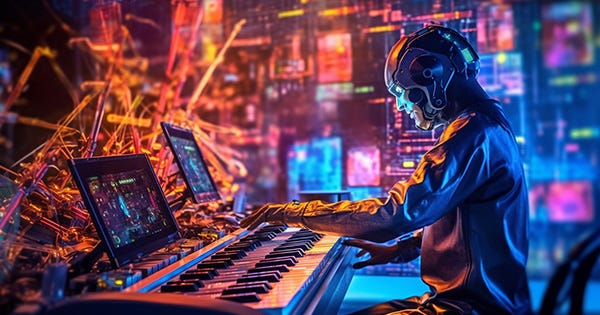
Musicians have gained access to an entirely new category of creative tools. Suno AI offers a web-based interface where a user simply types a prompt and receives two song variants within seconds. MusicFX DJ, developed by Google in collaboration with Grammy-award-winning musician Jacob Collier, allows real-time music generation where musicians mix musical concepts as text prompts, blending genres, instruments, and moods in real time to improvise live DJ sets or search for new melodic ideas.
The significance here extends beyond speed. These tools lower the barrier to musical experimentation. A composer without formal training in certain genres can now rapidly prototype arrangements, exploring harmonic frameworks and rhythmic ideas that previously required years of practice. The composer maintains artistic intent—deciding which AI suggestions to refine, which to discard, and how to shape the final composition—but the mechanical labor of ideation is shared with an AI collaborator.
This arrangement aligns with flow theory: by handling the initial generative work (which can be cognitively taxing), AI enables the musician to focus on the high-level creative decisions—texture, dynamics, emotional arc—that make the composition distinctive and emotionally resonant.
Writing and Content Creation
Writers benefit from AI tools like Jasper and Claude that can generate multiple content concepts rapidly, helping overcome writer’s block by providing starting points for refinement. AI writing assistants generate content drafts that provide unique starting points, but the human writer maintains editorial control, selecting which concepts to pursue and infusing them with authentic voice, emotional depth, and contextual nuance.
The flow mechanism is similar to music and design: AI handles the initial conceptual generation (which can feel like staring at a blank page), and the writer focuses on what requires human judgment—crafting voice, ensuring emotional resonance, and ensuring ideas land with the intended audience.
The Mechanics: How AI Creates Conditions for Flow
The research on flow state AI reveals a structured process for how organizations and individuals integrate these tools:
Phase 1: Observation Without Change
AI systems quietly track the individual’s attention span, interruptions, and natural work rhythms without making modifications. This establishes a baseline, revealing when the person is naturally most focused and what breaks flow.
Phase 2: Small-Scale Intervention
The system begins with low-effort, high-impact changes: digital distraction filtering (notification triage), basic task organization, and preliminary scheduling protection of deep work windows.
Phase 3: Scaling and Advanced Integration
Once basic distractions are managed, the system introduces more sophisticated tools: predictive scheduling that anticipates and prevents bottlenecks, adaptive environment controls, and real-time feedback on focus quality. Rather than forcing rigid productivity structures, these systems learn the individual’s natural patterns and amplify them.
Phase 4: Seamless Integration
The final stage integrates flow-enhancing features directly into existing tools (design software, project management apps, communication platforms) so creatives never leave their working context to access support systems.
This iterative approach respects how real creative work happens. It avoids the change-management friction of forcing new tools and processes, instead working within existing workflows while systematically reducing friction points.
Quantified Impact
| Metric | Value | Source |
|---|---|---|
| Productivity increase during flow state | 5x | |
| Creativity boost during flow state | 700% | |
| Annual hours lost to interruptions (avg. professional) | 581 | |
| Time required to refocus after interruption | ~23 min | |
| Reduction in manual design task time | 30% | |
| Increase in uninterrupted focus time (documented case) | 15 min → 90 min | |
| Weekly work time saved by AI tools | 4 hours | |
| Productivity increase for AI-adopting companies | 40% | |
| Creative teams using AI daily | 30% | |
| Creative teams fully integrated with AI | 2% | |
The data reveals both the opportunity and the current state of adoption. While AI tools demonstrably extend uninterrupted focus sessions and reduce time on mechanical work, only 2 percent of creative teams have fully integrated these tools into their workflows, suggesting substantial untapped potential.
AI as Collaborator, Not Replacement
A critical finding across all creative domains is that artists do not experience AI as threat to their creativity, but rather as a co-creator that handles the tedious elements of execution. This aligns with both neuroscience and practical experience: the parts of creative work that AI automates—repetitive edits, asset organization, initial drafts—are precisely the parts that prevent flow. The parts that remain irreplaceable—artistic vision, emotional resonance, original thinking, style—are what artists focus on when friction is removed.
Jazz musicians in flow studies showed increased brain activity in auditory and visual areas while showing decreased activity in executive control regions. They were not “trying harder” to focus; they were letting go and allowing domain expertise to operate. AI enables this by handling the cognitive burden that would otherwise activate those executive control regions.
Photographer Emma Hornick uses Aftershoot to automatically cull and rate thousands of wedding photos according to her aesthetic preferences. Rather than diminishing her creative role, this automation enables her to spend time on what she values most: refining the strongest images, exploring different styles for different moments in the day, and making artistic decisions about how to tell the couple’s story. AI handled the mechanical filtering; she brought the vision.
Barriers and Future Integration
Despite clear benefits, adoption remains uneven. Over 60 percent of creative teams cite lack of expertise as the biggest challenge to AI adoption, followed by difficulty integrating new tools into legacy workflows and skepticism about whether specific tools genuinely improve creative output.
The path forward involves targeted training, vendor partnerships that understand creative workflows, and most importantly, including creative teams in the selection and implementation of new systems. Early adopters who have overcome these barriers report not just higher output, but more fulfilled, engaged staff. When creatives are liberated from administrative burden and distraction, they experience work as more meaningful and creative.
Conclusion: The Future of Creative Work
AI is not automating away artistic creativity; it is enabling artists to spend more time in the psychological and neurological state where creativity actually happens. By eliminating friction, filtering distractions, optimizing environments, and automating low-value tasks, AI creates the conditions for the brain to enter the state of expertise-driven flow that neuroscience has shown underlies breakthrough creative work.
The businesses, studios, and individual artists who integrate these tools thoughtfully will gain a structural advantage: they will spend proportionally more time in deep creative work and less time in administrative overhead and context-switching. The competitive advantage is not in the tools themselves, but in the hours of uninterrupted human creativity the tools enable.
For artists who embrace this collaboration—using AI to shoulder the mechanical burden while maintaining full creative control—the message is clear: the future of creative work is not human versus machine, but human augmented by machine, focused on what only humans can contribute: vision, taste, emotional truth, and meaning.