
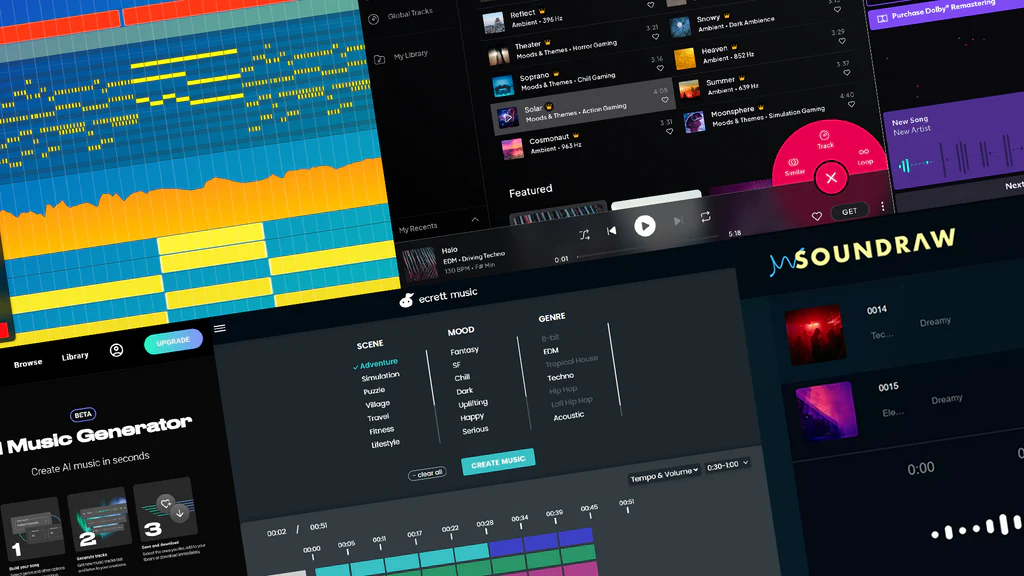
The landscape of AI-generated music for audiovisual media has evolved dramatically in 2025, with sophisticated platforms now enabling professionals and independent creators to produce high-quality soundtracks quickly and cost-effectively. This comprehensive guide covers the leading AI music software solutions across these creative industries, their capabilities, and how to implement them into production workflows.
Market Leaders and Their Specializations
Suno stands out as the fastest-growing general AI music generator. It delivers studio-quality audio through its v5 model at 44.1 kHz and uniquely offers 12-stem exports, allowing creators to extract individual instruments for further customization. The platform’s web-based generative audio workstation includes DAW-like functionalities, real-time editing, and reference track uploads for style transfer. For filmmakers seeking rapid prototyping or indie creators on limited budgets, Suno’s combination of speed and versatility makes it particularly valuable.
Udio distinguishes itself as the superior choice for film and television scoring. It generates music with better vocal quality, more cohesive harmonies, and genuine compositional depth compared to alternatives. The platform excels at maintaining musical consistency while allowing sophisticated tempo and key changes—crucial qualities for professional film work. Its ability to analyze and extend reference audio makes it ideal for composers who have initial musical ideas and need AI assistance to develop complete arrangements.
AIVA (Artificial Intelligence Virtual Artist) offers a more composer-focused approach. As the world’s first AI composer recognized by the SACEM music society, it provides over 250 predefined musical styles and includes a professional piano roll MIDI editor for granular note-by-note control. This makes AIVA particularly valuable for filmmakers and game developers who demand full creative authority over compositions. The platform supports genre blending and exports in multiple formats (MP3, WAV, MIDI), with full commercial copyright ownership available on the Pro plan.
Soundverse bridges the gap between ease of use and professional licensing clarity. Its Text-to-Music generation converts simple descriptions into full scores, while the SAAR AI voice assistant enables collaborative ideation. Soundverse offers tiered licensing specifically designed for different use cases: Free tier for personal projects, Creator tier for royalty-free YouTube and podcasting, Pro tier for streaming distribution, and Enterprise tier with full copyright ownership and sync licensing for film, TV, and games. This structured approach directly addresses legal concerns that have plagued AI music adoption.
Specialized Platforms
For game developers, TopMediai and MusicCreator AI provide game-specific tools with predefined styles like 8-bit, orchestral, lo-fi, and electronic music optimized for different game scenes. These tools prioritize speed and beginner accessibility over granular control.
Reactional Music represents a different category entirely—middleware rather than a generator—specifically designed for adaptive game audio. It uses machine learning to analyze game events in real-time and dynamically adjust music through vertical layering (adding/removing instrumental tracks) or horizontal sequencing (transitioning between pre-composed sections). This technology enables what game composers call “note-by-note adaptation,” where the AI responds to individual gameplay events while maintaining musical coherence.
Key Capabilities for Each Industry
Film and Television: AI music software dramatically reduces production costs and timelines. Traditional film scoring costs $5,000+ per minute; AI-generated scores can be created in minutes. The platforms excel at dynamic scoring—music that evolves with scene transitions and emotional arcs. Netflix has already begun experimenting with AI-generated scores for documentaries, while the indie film Zone Out successfully used AI to create atmospheric tension. Modern tools support rapid iteration, allowing directors and composers to experiment with dozens of musical variations before settling on final versions.
Video Games: Adaptive music is the defining requirement. AI solutions must generate music that responds to player actions, adjusting tempo, intensity, and instrumentation based on gameplay events. The vertical adaptation approach layers multiple instrumental tracks that mix in real-time (for example, adding percussion during combat), while horizontal adaptation transitions between distinct musical sections to signal narrative changes. This responsiveness transforms music from passive accompaniment to interactive gameplay element, significantly enhancing immersion.
Commercial Video Content: For YouTube creators, TikTok producers, and podcasters, royalty-free options like Beatoven.ai and Mubert provide rapid, affordable soundtrack generation. These platforms prioritize simplicity—users select mood and genre, and the AI generates royalty-free tracks ready for immediate use.
Implementation Workflows
The modern AI music production pipeline differs substantially from traditional composition. Rather than commissioning an orchestral recording, contemporary workflows begin with spotting (identifying where music should appear) and text description of emotional intent. The director or composer writes prompts like “melancholic piano with subtle string accompaniment, building tension over 90 seconds”. The AI generates multiple options in seconds. The creator refines these outputs—adjusting tempo, instrumentation, and dynamics—then exports in their preferred format (MP3 for video, STEMS for mixing, MIDI for further arrangement).
For game audio specifically, composers generate AI-assisted stems (individual instrument tracks) that integrate into game engines via Blueprint scripting in Unreal Engine or similar systems in Unity, enabling real-time mixing and adaptive triggering based on gameplay events. Professional studios employ Reactional Music middleware that analyzes these AI-generated stems and applies dynamic rules to synchronize with player actions.
Licensing, Copyright, and Commercial Rights
The legal landscape underwent significant clarification in 2025. The U.S. Copyright Office ruled that AI-generated music can be copyrighted if humans play an essential creative role—writing lyrics, adjusting arrangements, recording live vocals, or performing mixing. Fully AI-generated content without human input enters the public domain upon creation.
Suno and Udio have completed licensing deals with all three major music companies (Universal, Sony, Warner), implementing fingerprinting systems similar to YouTube’s Content ID to track AI influence on outputs. This enables rights holders to monitor usage and collect royalties. BandLab allows artists to mark tracks “Open to AI licensing,” creating a structured database for AI companies seeking training permissions.
Subscription costs vary based on intended use. Suno’s Standard tier ($10/month, billed annually at $8/month) serves personal creators, while Pro tier ($30/month) includes monthly download caps suitable for professional use. Udio mirrors this pricing. Soundraw offers tiers from $16.99/month (commercial YouTube use, MP3 only) to $49.99/month (unlimited downloads, MP3/WAV/STEMS). Beatoven.ai costs $30-100/year for personal creators, or $39/month for commercial production. Enterprise solutions like Soundverse’s sync licensing tier require custom quotes but provide unrestricted commercial rights for film, TV, and game productions.
Emerging Developments and Future Direction
Nearly 25% of music producers have already integrated AI tools into workflows as of late 2025. Massive Music is developing AI-powered search tools to help producers identify mood and character requirements directly from footage. Suno’s latest updates enable longer track generation, studio-grade audio, and expanded genre combinations like jazz-house or EDM-folk. Unreal Engine 5’s new MetaSounds feature offers modular, programmable audio generation enabling more sophisticated adaptive scoring.
The convergence of these technologies suggests that AI-assisted music composition will become standard industry practice rather than novelty. The competitive advantage will shift from having access to AI generation tools (now commoditized) to mastering effective prompt engineering, understanding licensing implications, and creating genuinely distinctive musical styles through hybrid human-AI collaboration.